AI marketing
Case Notes: What It Actually Took to Get a B2B Client Cited in AI Overviews
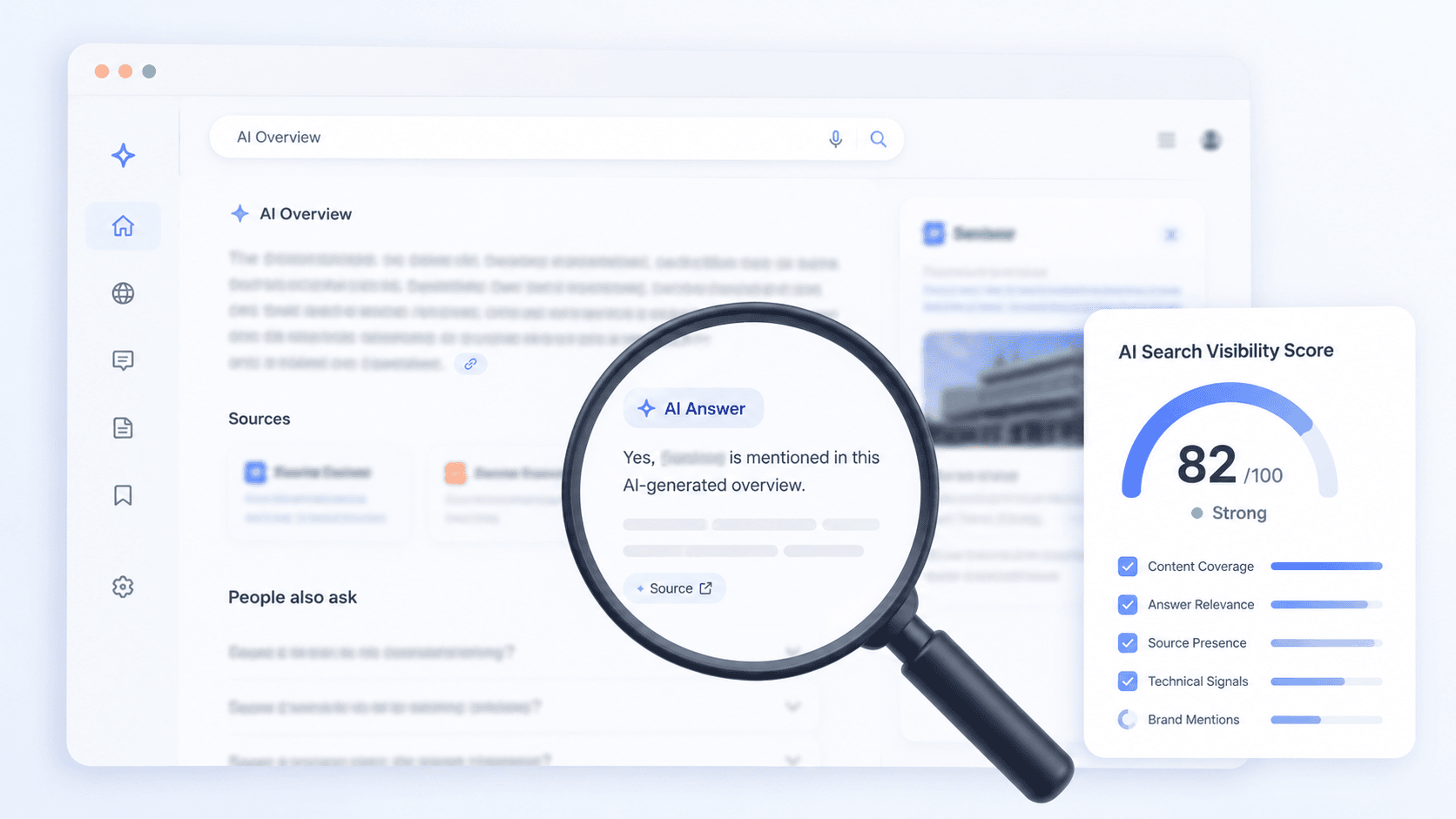
A practical case note on getting a B2B client cited in AI Overviews. Explore the content, authority, entity, technical SEO, and answer-focused strategies that helped improve AI search visibility—and the lessons businesses can apply to their own GEO and AEO efforts.
The client came to us with a problem they could not name.
Their rankings were fine. Traffic was steady. But their sales team kept hearing prospects say they had "asked ChatGPT" or "seen a summary on Google" and come away with a shortlist that did not include them.
They assumed it was an SEO problem. It was not. Their SEO was working. It just was not doing the thing they had always assumed it did.
Why good rankings were not producing citations
This is the part most teams have not internalized yet.
Ranking and citation used to be the same thing. If you were in the top ten, you were the source. That relationship has broken. Recent analysis found only around 38% of pages cited in AI Overviews also rank in the top ten for that query, down from roughly 76% in mid-2025. One 40,000-keyword study found the large majority of AI Mode citations do not come from the organic top ten at all.
So a company can hold position three, get decent traffic, and be entirely absent from the summary sitting above their own listing. That was our client's exact situation, and it is why their rank tracker showed nothing wrong.
Three specific things were causing it.
Their content was keyword-led, not question-led. They had a strong page targeting a valuable head term. It did not answer any of the six questions a buyer actually has before shortlisting: what the work involves, how long it takes, what it costs, what goes wrong, how to evaluate vendors, and what the first ninety days look like. AI systems break complex queries into related subtopics before answering. Their page covered one of them.
Answers were buried. Useful information existed, four hundred words down, inside long paragraphs. Nothing at the top of the page could be lifted cleanly.
The brand had a category presence but not a category relationship. They had a page about the topic. What they did not have was a recognizable body of work that made them an obvious source on it.
Days 1 to 30: build the baseline, not the content
We published nothing in the first month. That is usually the hardest part of the pitch and the most important part of the work.
Instead we built a query set of around forty commercially meaningful questions, sorted into four tiers:
Category questions: What the thing is.
Problem questions: How companies solve it.
Evaluation questions: How buyers compare options and vendors.
Decision questions: What to consider before committing.
The instinct is to chase the top tier because the volume is there. We prioritized the bottom two, because that is where a citation actually influences a shortlist. "AI consulting" produces broad results and unqualified attention. "How should a financial services firm evaluate an AI implementation partner" produces a buyer three weeks from a decision.
For every query we logged whether an AI Overview appeared, which sources it cited, whether our client appeared, which competitors did, what type of page got cited, and whether the client's existing content could plausibly have answered the same question.
That log is the baseline. Without it, every claim made ninety days later is unverifiable, which is exactly why so many GEO case studies contain no numbers.
Days 31 to 60: rebuild the pages that deserved citing
We rewrote existing pages rather than publishing new ones. Nine pages in total, prioritized by commercial value and by how close their existing content was to being genuinely useful.
Five changes to each.
The answer moved to the top. First hundred words, direct, quotable. Studies of AI Overview citations consistently find the cited snippet sits near the top of the source page. Long warm-up introductions exist to build dwell time and they cost you citations.
Depth was added beneath it. A short answer alone is a thin page. Under each one we built the definitions, the process, the risks, the alternatives, the decision criteria and the trade-offs. That serves the skimmer and the researcher from the same page.
Headings became questions. "Benefits" became "What are the business benefits of X." "Process" became "How does X actually work." Not keyword stuffing. Just naming what the section answers.
Internal links became contextual. Each priority page was connected to its genuine neighbors, both directions. Orphaned commercial pages got adopted.
Adjectives were replaced with evidence. This was the biggest single change and the one the client resisted most. "Industry-leading expertise" became what they have actually implemented, for which industries, using what method, measured how, with what trade-offs. Systems cannot ground an answer in marketing language. They can ground it in specifics.
Days 61 to 75: fix the entity
Content was only half of it. We then audited how coherently the business existed as an identifiable thing.
Company description, service naming, author identification, organization schema, about-page content, the consistency of all of it across LinkedIn, directories, publication bylines and partner sites.
The client was describing the same service three different ways across their own site and a fourth way on LinkedIn. A human reconciles that instantly. A system deciding whether these are one offering or four routes around the ambiguity.
Schema was implemented properly here, but framed correctly. Google is explicit that no special markup is required for AI Overviews. Structured data removes ambiguity about what a page is. It cannot create authority a page does not have. Anyone selling schema as the AI visibility fix has the causation backwards.
Days 76 to 90: measure the right thing
We reran the full query set against the baseline. What we tracked, in order of usefulness:
Citation presence per query, not aggregate. Engines disagree with each other constantly, so an averaged score across platforms hides everything that matters.
Query tier of the citations. Ten citations on category questions is worth less than three on decision questions. We report both and weigh the second.
How the brand was described. Nobody tracks this and it matters. If AI systems are describing your services inaccurately, this is the only way you find out, and it is fixable.
Competitor displacement. Which competitors dropped out of answers we entered.
Commercial signal. Referral traffic, branded search movement, and inbound where the prospect mentioned an AI tool.
One honest limitation worth stating publicly: Google's Search Generative AI reports launched on 3 June 2026 with impressions only. No clicks, no click-through rate, no queries. Bing Webmaster Tools has offered AI performance reporting since February 2026, globally, including citations and grounding queries, which is currently more than Google gives you. Nobody has clean click attribution from AI answers yet. Any agency implying otherwise is guessing.
Three things we would do differently
- We would not have rewritten nine pages: Five would have been enough to prove the model, and the other four could have waited for evidence. Doing all nine at once made attribution harder than it needed to be.
- We would have started the third-party work in week two, not week nine: Earned mentions, expert commentary and credible external references take the longest to land and we started them last. That is a sequencing error, not a strategy one, and it cost us most of a quarter of compounding.
- We would have set expectations differently on the timeline: Ninety days is enough to move citation presence on mid-intent queries. It is not enough to move the most competitive decision-stage questions, where the incumbents have years of accumulated external authority. We know that now. We said it less clearly at the start than we should have.
Five questions to ask any GEO agency
If you are hiring for this, these separate the operators from the people who discovered the acronym last quarter.
How will you pick which queries matter commercially?
If the answer is search volume, walk.
What is your baseline method, and will I see it?
No baseline means no provable result.
What will you change on my site beyond publishing?
If the plan is only new content, it is a content plan wearing a GEO label.
How do you separate meaningful citations from vanity ones?
They should already have a tiering method.
What can you not measure yet, and why? Anyone who claims full click attribution from AI answers is either uninformed or hoping you are.
The actual lesson from ninety days
There is no AI Overview hack. We looked.
What worked was unglamorous: find the questions that influence a purchase, answer them better and earlier on the page than anyone else does, remove the ambiguity about who you are, and build enough external evidence that the claim is not just yours.
That is the same work good SEO always required, held to a higher standard, and measured against a different question. Not "did we rank," but "when a system had to answer this, did it have enough reason to use us."
Want your own baseline before you spend anything? Book a free growth audit. Thirty minutes, and you leave with your citation baseline across the engines and a written first move, hire us or not.