AI marketing
GEO Explained: How to Get Cited by AI Search in 2026
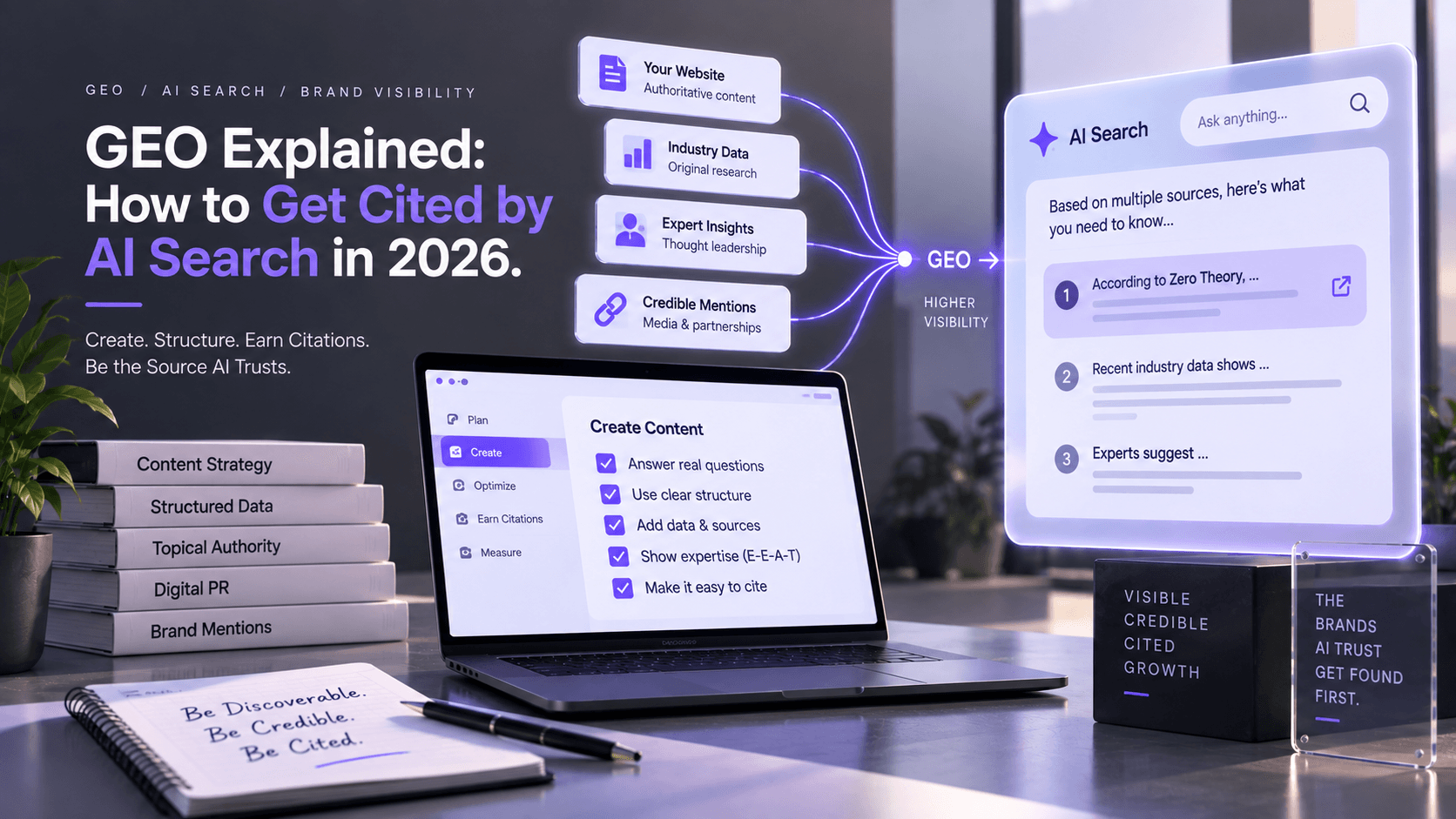
AI search is changing how people discover brands, products, and information. Traditional SEO rankings are no longer the only visibility metric—being cited in AI-generated answers is becoming equally important. This guide explains GEO (Generative Engine Optimization), how AI search engines select and cite sources, and the practical strategies businesses can use in 2026 to improve their chances of being referenced in AI-generated responses.
Search is changing, and not at the edges. For years the goal of SEO was simple: rank a page, earn the click, convert the visitor. AI search rewrites the interface. Instead of handing users ten links to sift through, AI systems now synthesise information from multiple sources and just answer the question. Google generates AI Overviews. ChatGPT searches the web and links its sources. Perplexity is built around cited answers. Gemini grounds its responses in live Google Search.
That creates a brand-new visibility question: what does it take for an AI system to understand, trust, retrieve, and cite your content? The discipline that answers it is Generative Engine Optimization, or GEO.
GEO isn't a replacement for SEO. It's the work of making your brand, expertise, content, entities, and evidence easier for AI-powered search to understand and use when it builds an answer. Zero Theory frames the distinction plainly: SEO stays foundational, while GEO focuses on making a brand understandable, mentionable, and recommendable inside AI search experiences.
What is GEO?
Generative Engine Optimization is the process of improving a brand's visibility within AI-generated search. Traditional SEO asks "how do I rank for this query?" GEO asks "how do I become a source an AI system can confidently use when answering it?"
That difference matters more than it first looks. A page can rank at the top of Google and still never make it into an AI answer. And a source that isn't the first blue link can still get picked because it holds a particularly useful, specific, or well-evidenced piece of information. Rankings still count. It's just that visibility has become multidimensional.
How AI search works, at a high level
Nobody outside these companies has the full retrieval systems, but the basic flow is consistent across platforms. First, the system interprets the question, so a query like "best AI marketing agencies for SaaS in India" gets broken into concepts: AI marketing, agency, SaaS, India, commercial intent, recommendation criteria. Second, it retrieves potentially relevant information from available web sources. Third, it evaluates and synthesises those sources into something useful. Fourth, it generates the answer and may cite sources, ChatGPT Search, for example, links out to sources, and OpenAI advises publishers who want to be discoverable to avoid blocking OAI-SearchBot. Gemini's Search grounding works similarly, searching, processing, synthesising, and returning inline citations. The practical takeaway is blunt: your website has to be understandable before it can ever be useful.
SEO vs GEO
The two overlap heavily. Technical SEO, crawling, indexing, content quality, authority, links, and search intent all still matter. GEO simply adds a layer on top.
The shift is from ranking to retrieval and inclusion, from keywords to concepts and entities, from clicks to citations and mentions, from the SERP to the AI answer, from backlinks to broader evidence and authority, and from website visibility to brand visibility inside answers. The mistake is treating GEO as "SEO with AI keywords." It isn't that, and the difference is exactly why funnels leak when channels aren't connected into one system.
What makes content more likely to be cited?
There's no guaranteed formula, but a few principles hold up. Be directly relevant: if someone asks "what is GEO?", lead with the answer, not 1,500 words of trend-setting throat-clearing first. Make claims specific: "AI search systems retrieve web sources and construct answers with citations" is far more citable than "AI search is changing everything." Demonstrate real expertise through original research, case studies, first-hand observation, data, examples, and clear definitions. And build topical depth, one article rarely establishes authority, but a pillar plus supporting platform posts, technical pages, and commercial pages tells a search system what your site genuinely knows.
Build an answer-first architecture
A strong GEO page makes the important information easy to extract, using clear headings, short paragraphs, definitions, lists, tables, examples, FAQs, direct answers, and supporting evidence. This isn't writing for robots. It's written clearly for humans. If a person can find the answer fast, a retrieval system has a much better shot at finding the relevant passage too, which is the same editorial discipline behind producing AI content without the slop.
Entity clarity and structured data
AI systems need to understand entities and relationships, not just pages. Keep your brand name, description, services, locations, industries, founders, products, and profiles consistent across the web. If your site says "AI-first growth agency," your LinkedIn says "full-service advertising agency," and a directory says "SEO consultancy," you make the entity harder to interpret. Structured data supports this: Organization, Article, FAQ, Product, Service, Person, and Breadcrumb schema label your information for machines. Schema won't rescue weak content, but on strong content it makes the entities and relationships clearer.
Build citation-worthy content
The core GEO question is simple: why would an AI system choose your page over the hundred others on the same topic? If the honest answer is "we used the keyword more times," you have a problem. Better answers: we ran original research, we built a unique framework, we have first-hand client experience, we have proprietary data, we explain it more clearly, we answer questions competitors ignore. Citation-worthy content gives the system something worth citing.
Authority, questions, and measurement
Your own site is one part of a bigger footprint. AI encounters your brand through publications, reviews, partner sites, interviews, podcasts, research, communities, and profiles, so GEO is partly an entity-reputation problem. Earn legitimate references rather than manufacturing them. On the content side, expand from keyword research to prompt research across definitional, problem-led, commercial, comparison, and qualified questions, then watch how AI actually answers them.
Measurement changes too. Beyond rankings, impressions, and clicks, track citation rate, mention rate, recommendation rate, citation position, competitor share, and prompt coverage. And remember there's no single "AI search ranking", Zero Theory's own testing shows ChatGPT and Perplexity can recommend different brands for the same query because their retrieval systems differ. So don't ask "how do I rank in AI?" Ask "where does my ICP search, and how does each environment retrieve and cite?"
A practical GEO framework
Seven steps carry a real program: define your entities, build your prompt universe, audit current AI visibility across ChatGPT, AI Overviews, Perplexity, and Gemini, find the citation gaps where competitors appear and you don't, build answer-first content to fill them, strengthen authority through credible mentions and original citations, then monitor continuously, because a one-time audit is not a strategy.
Can anyone guarantee AI citations?
No. Treat anyone promising guaranteed ChatGPT, AI Overview, Gemini, or Perplexity citations with caution. These systems are dynamic: retrieval changes, sources change, queries change, models change, and competitors keep publishing. You can optimise the conditions that make your content more useful and retrievable. You cannot control the final answer.