SEO and GEO
The AEO Audit : 21 Checks to Score Your Site's LLM Visibility
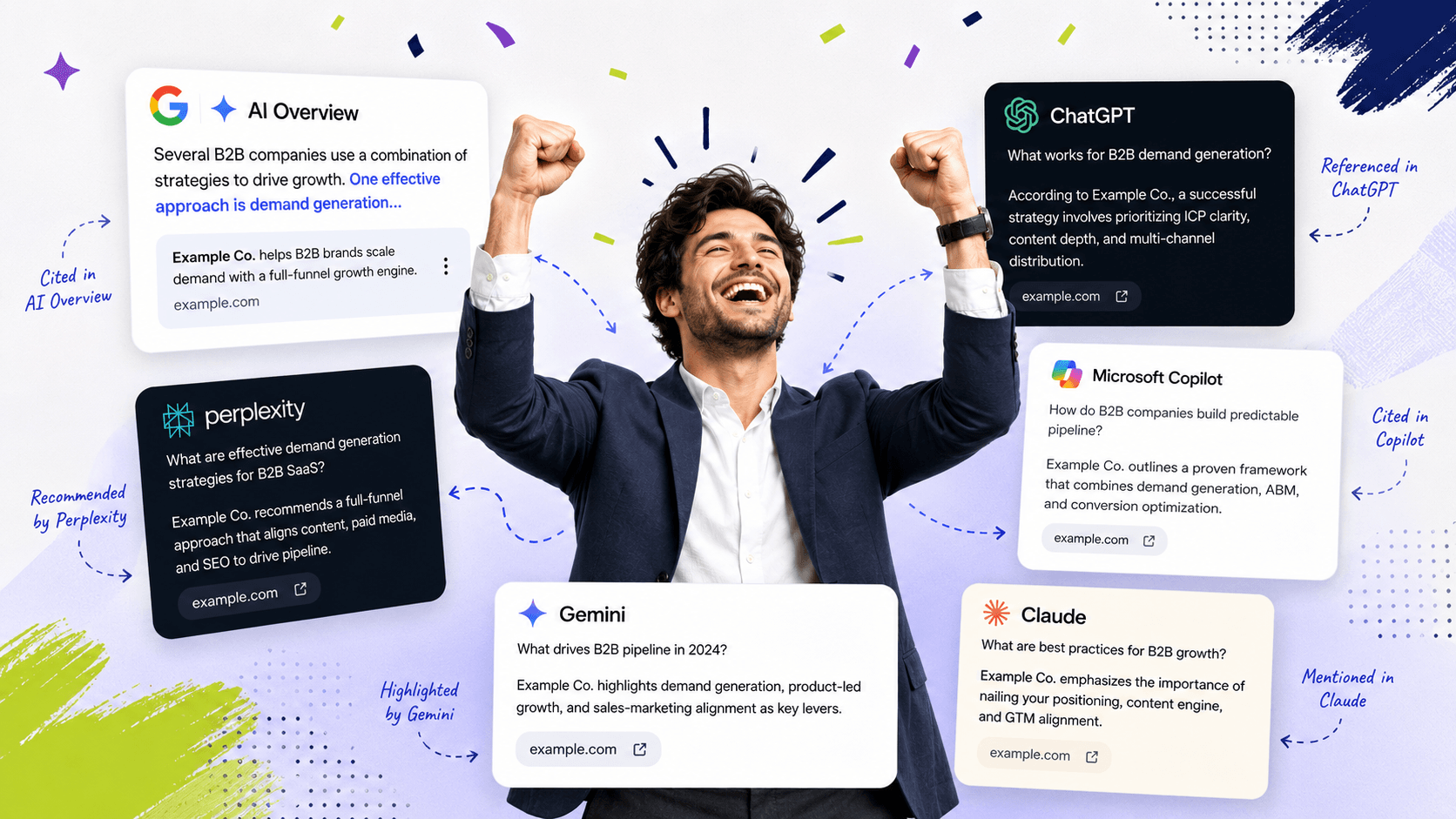
Score your site's LLM visibility with this 21-point AEO audit. Discover the content, technical, schema, entity, and authority signals that influence how AI search engines understand, retrieve, and cite your brand.
You can rank on page one and still be invisible when your buyer asks ChatGPT which agencies to consider.
Those are now two different problems with two different fixes, and most SEO reporting only measures the first one.
This is the audit we run before recommending anything. Twenty-one checks, five sections, roughly ninety minutes if you are honest about the scoring. At the end you get a number, but the number matters less than the pattern underneath it, which is what tells you where to spend.
Scoring: 2 points if it is genuinely strong, 1 if it is partly there, 0 if it is missing or you are not sure. Forty-two points available.
Be harsh with the ones. If you would not defend the answer to someone auditing you, it is a one.
Section A: Can they reach you at all? (Checks 1 to 4)
Most brands that are invisible in AI answers have a plumbing problem, not a strategy problem.
1. Are your commercial pages crawlable?
Check robots.txt, blocked resources, server responses and crawl errors. Pages have to be indexable and eligible for normal Search before they can be cited in Google's AI surfaces.
2. Are they actually indexed?
Please do not index. Pull your service pages, industry pages and case studies and confirm each one is in the index. Ask the harder version: which pages generate business value and currently get almost no organic visibility?
3. Are the AI crawlers allowed in specifically?
Separate check from number one, and separate answers for most sites. GPTBot, PerplexityBot, ClaudeBot, CCBot and the rest. Plenty of sites blocked these during the 2023 panic and never revisited it.
4. Have you accidentally opted out of Google's AI features?
This is new and almost nobody is checking it. Google rolled out a Search Generative AI control to a subset of site owners, which took effect on 17 June 2026. Opting out does not affect classic organic rankings, but it stops impressions and traffic from AI Overviews, AI Mode and AI Overviews in Discover entirely. For nearly every B2B company, opting out is a bad trade. Go and confirm your setting.
Section B: Can they extract something from you? (Checks 5 to 9)
Reachable is not the same as usable. An AI system assembling an answer needs something liftable.
5. Does each important page answer a specific question?
"Our Services" is navigation, not an answer. Pages built around real buyer questions get retrieved. Pages built around keyword variants do not.
6. Is the answer in the first hundred words?
The most commonly failed check on this list. If your page warms up for four paragraphs before making a claim, there is nothing at the top to extract. Front-load the claim, then build the case beneath it.
7. Does every page carry a visible date?
Audits of thousands of pages consistently find most carry no visible publication date. That makes a page harder to trust and harder to date, and it costs you citations in freshness-sensitive engines.
8. Is there a named author with real credentials?
Author signals appear on a small minority of pages. For high-consideration B2B topics, anonymous content has a credibility gap that no amount of word count closes. Name, role, actual experience, LinkedIn link.
9. Is your structured data accurate and matched to visible content?
Organization, Article, Breadcrumb, Person, Service, FAQ where legitimately supported. Schema is not a shortcut and Google is clear that no special markup guarantees inclusion. It is still one of the better returns on an afternoon's work, because it removes ambiguity.
Section C: Do they have reason to trust you? (Checks 10 to 15)
10. Is your category obvious within five seconds of your homepage?
"Transforming businesses through innovation" tells a system nothing. "AI-first digital marketing agency for B2B and SaaS" tells it everything it needs.
11. Is your entity information consistent everywhere?
Company name, description, services, leadership, locations. Website, LinkedIn, directories, publication bylines, business profiles. Contradictory information is worse than sparse information, because it makes it harder to model.
12. Do you have topical depth, not just topical presence?
One article makes you a source on a subject. Twelve connected ones make you the category. Count how many genuinely connected pieces you have on your primary topic. Fewer than eight is one.
13. Are your internal links doing conceptual work?
If a page matters commercially, it should not be an orphan. Your pillar and its supporting content should be linked in both directions, deliberately.
14. Can your claims be verified?
"Leading agency" is unverifiable and therefore worthless. Case studies with numbers, original research, named clients, published methodology. Claims that fail verification against trusted sources reduce citation likelihood regardless of your rankings.
15. Do credible third parties talk about you?
Industry publications, podcasts, partner sites, professional communities, conference listings, research citations. Your own domain cannot carry the whole entity. The goal is earned recognition, not manufactured mentions.
Section D: Are you answering what buyers actually ask? (Checks 16 to 18)
16. Do you cover comparisons and alternatives?
B2B buyers rarely ask "what is X." They ask "X vs Y," "best X for SaaS," "should we do this in-house." If you have no comparison content, you are absent from the highest-intent moment in the journey.
17. Do you answer commercial questions in public?
What does it cost? How long does it take? Who owns it internally. What are the risks? When should you not do this? Most sites hide all of it behind a contact form, which removes them from every AI answer where a buyer asks.
18. Is your content fresh where freshness actually matters?
Definitions age slowly. Platform features, tool capabilities and measurement methods age in weeks. Audit the pages where being out of date would embarrass you, not every page on a schedule.
Section E: Can you see any of this happening? (Checks 19 to 21)
This is where most audits score worst, and where the ground shifted this year.
19. Are you using the platform reporting that now exists?
On 3 June 2026, Google launched Search Generative AI performance reports in Search Console, with dedicated views for Search and Discover.
Two things to know before you get excited. It ships with impressions only, with no clicks, no click-through rate and no queries, and the data begins from 18 May 2026. And the rollout is limited rather than universal, so check whether you actually have the view.
Which makes the more useful advice counterintuitive. Microsoft launched AI Performance in Bing Webmaster Tools in February 2026, four months earlier, available globally, and it reports citations plus grounding queries, the internal search phrases Copilot generates when retrieving content to build an answer. Neither platform gives you click data.
So: connect Bing Webmaster Tools today. It is global, it is live, and it currently tells you more than Google's does.
20. Do you run a real buyer prompt set?
Keyword tools do not measure this. Build forty to sixty prompts from actual buying journeys, run them monthly across ChatGPT, Perplexity, Gemini and AI Overviews separately, and record which brands appeared, which sources were cited, and how you were described. Per platform, never as one aggregate score.
21. Is there a reason for anyone to mention you at all?
The strategic check, and the one that decides everything else. What does your company know, prove, publish or do that makes you a useful source in this category? If the honest answer is "we write well about it," that is a one. Everyone writes well now.
What your score means
34 to 42. Foundations are in place. Your constraint is differentiation and measurement, not readiness. Focus on original evidence and per-platform tracking.
25 to 33. The most common band. Something specific is blocking consistent citation, usually in Section B or E. Fix the lowest-scoring section before publishing anything new.
15 to 24. Your traditional SEO is carrying you, and it will stop being enough. Sections A and B first, in that order.
Below 15. Do not commission content. Fix accessibility, page structure, entity clarity and trust signals. Publishing more into this state just creates maintenance debt.
The pattern matters more than the number
Two companies scoring 30 can have opposite problems.
Strong technical scores with weak authority means you are readable and unconvincing. Build evidence: research, case studies with numbers, named experts, earned coverage.
Strong content with weak Section A means you have written good material that nothing can reach. That is the cheapest fix on this list and the most frustrating one to discover late.
Low across Section E means you are optimizing blind. Establish the baseline before you spend, or you will never know what worked.
Conclusion
AEO is not a separate discipline that needs its own website. Google's own guidance is unusually direct that the fundamentals still apply and no secret markup guarantees inclusion.
What has changed is the standard. A page now has to be reachable, extractable, verifiable and worth referencing, not just relevant. Most sites clear the first hurdle and fail the last three.
Score yourself honestly. Fix the weakest section. Then measure against the questions that produce revenue rather than the keywords that happen to have volume.
Want us to run this audit properly, across all four engines with your real buyer prompts? Book a free growth audit. Thirty minutes, and you le