SEO and GEO
How to Get Cited by ChatGPT: A Practical GEO Strategy for Brands
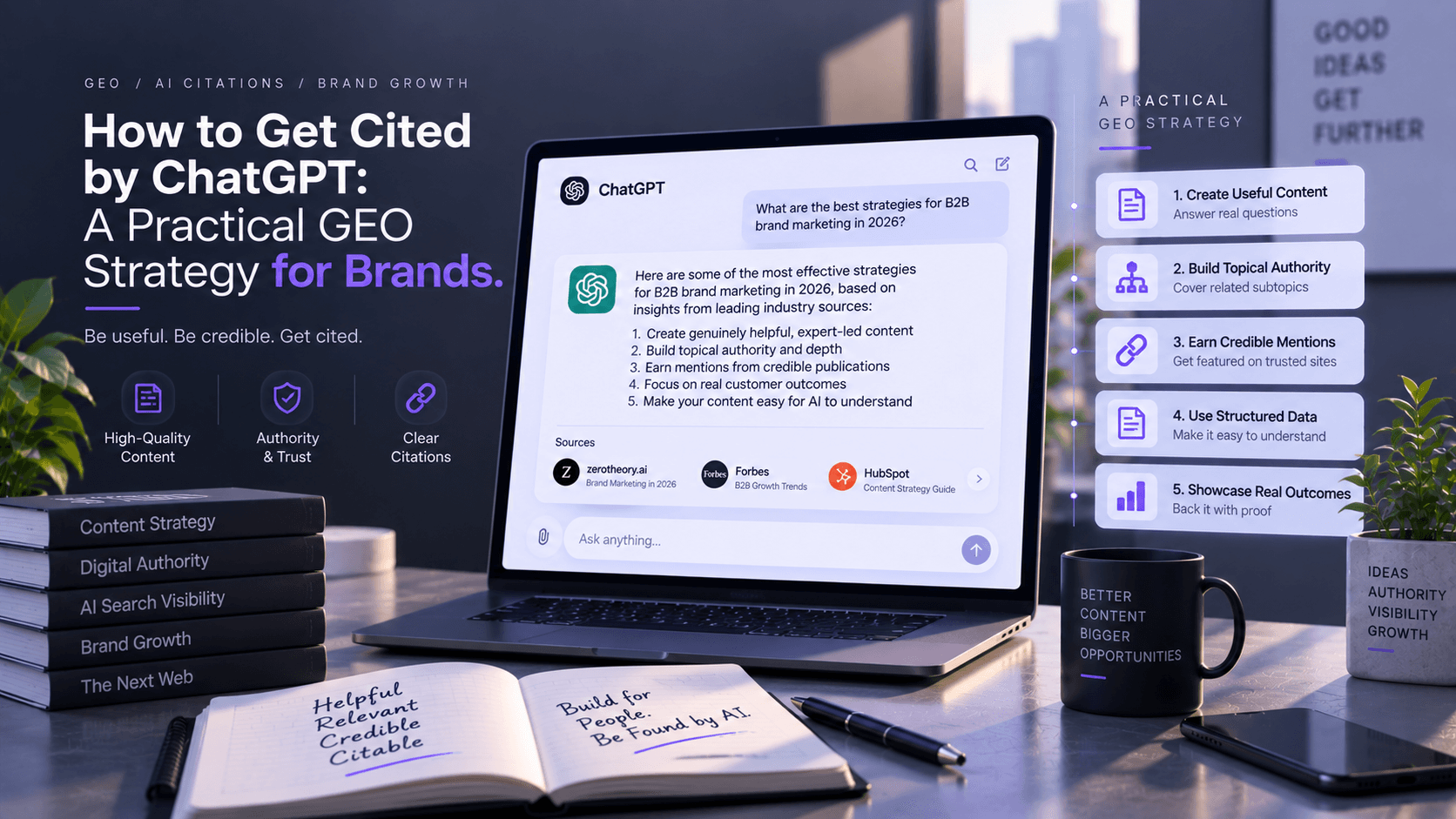
Being visible in ChatGPT is becoming an important part of modern search strategy as users increasingly rely on AI-generated answers to research brands, products, and services. This guide explains how brands can improve their chances of being cited by ChatGPT through Generative Engine Optimization (GEO), covering content quality, entity signals, topical authority, structured information, and trusted external mentions.
Ask ChatGPT "what are the best digital marketing agencies for SaaS companies?" and you want your brand in the running. But there's a big misconception here: you can't "rank in ChatGPT" the way you rank in Google.
ChatGPT Search can search the web, retrieve information, synthesise an answer, and link sources. OpenAI says any public website can potentially appear in ChatGPT search, and specifically advises publishers who want to be discoverable and clearly cited to avoid blocking OAI-SearchBot. So the objective changes. Instead of chasing one ranking position, you improve the probability that ChatGPT can find, understand, trust, use, and cite your information.
What "cited by ChatGPT" actually means
A citation isn't the same as a mention. ChatGPT might mention your company, link your site, cite a specific page, recommend your company, or use your information without making your brand the focus. Those are different outcomes, so track them separately.
How ChatGPT Search works
At a simplified level: user question, then a search decision, then query generation and retrieval, then source evaluation, then answer synthesis, then citations. OpenAI explains ChatGPT searches when current information would improve an answer, can use third-party search providers, and links to sources. Your content has to be useful at the retrieval stage, which starts with the shared GEO foundation covered in the GEO pillar.
The ChatGPT-specific moves
Make sure ChatGPT can access your site: This is the technical starting line OpenAI is explicit about: don't block OAI-SearchBot if you want to be discovered and cited. Review robots.txt, noindex directives, canonicals, crawlability, and server access. Don't assume your best content is automatically available.
Identify the prompts your buyers ask: then categorise them, educational ("what is GEO?"), commercial ("best GEO agencies"), comparison ("GEO agency vs internal team"), problem-solving ("why isn't my brand in AI search?"), and industry-specific ("best AI marketing agency for fintech"). That's your ChatGPT visibility map.
Answer the exact question, fast: If someone asks "what is blended CAC?", don't open with "digital transformation is reshaping D2C." Open with the definition, then expand, exactly as the live post on D2C growth beyond ROAS handles blended CAC.
Give ChatGPT something worth citing: through original research, benchmarks, proprietary frameworks, case studies, and first-party data. A "2026 SaaS SEO benchmark based on 500 websites" is a stronger citation asset than "10 SaaS SEO tips."
Keep your brand entity consistent: across name, description, services, industries, locations, leadership, website, and profiles, which matters even more for being recommended rather than merely cited.
Build third-party authority: through publications, podcasts, interviews, partner sites, and research citations, independent credibility, not fake mentions.
Build topic clusters: a GEO pillar linking to how-to-get-cited-by-ChatGPT, AI Overviews, Perplexity, Gemini, schema/entity, and an AEO audit gives the site real depth.
Use direct answers with natural-language headings ("how do you improve ChatGPT visibility?" beats "2026 Strategic Framework for Cross-Platform Generative Search Visibility Optimization")
Support claims with sources, especially statistics, pricing, and regulations, since ChatGPT itself reminds users citations can be incomplete or outdated
Optimise for recommendation queries: where ChatGPT needs to understand what you do, who you serve, what sets you apart, where you operate, and whether independent sources back it up.
Measure it, don't hack it
Build a prompt set and, for each, record whether the brand was mentioned, cited, or recommended, which URL was cited, and which competitors appeared. Then calculate mention rate, citation rate, recommendation rate, and competitor share. Ignore anyone selling "add this phrase" or "generate 1,000 AI articles" shortcuts; ChatGPT search is dynamic, and durable visibility comes from accessibility, relevance, authority, evidence, clarity, and entity consistency. The mindset shift: stop asking how to make ChatGPT mention you, and start asking what information ChatGPT would need to confidently include you in the answer.