AI marketing
D2C Growth Beyond ROAS: Blended CAC, Retention Curves, and Brand Spend Timing
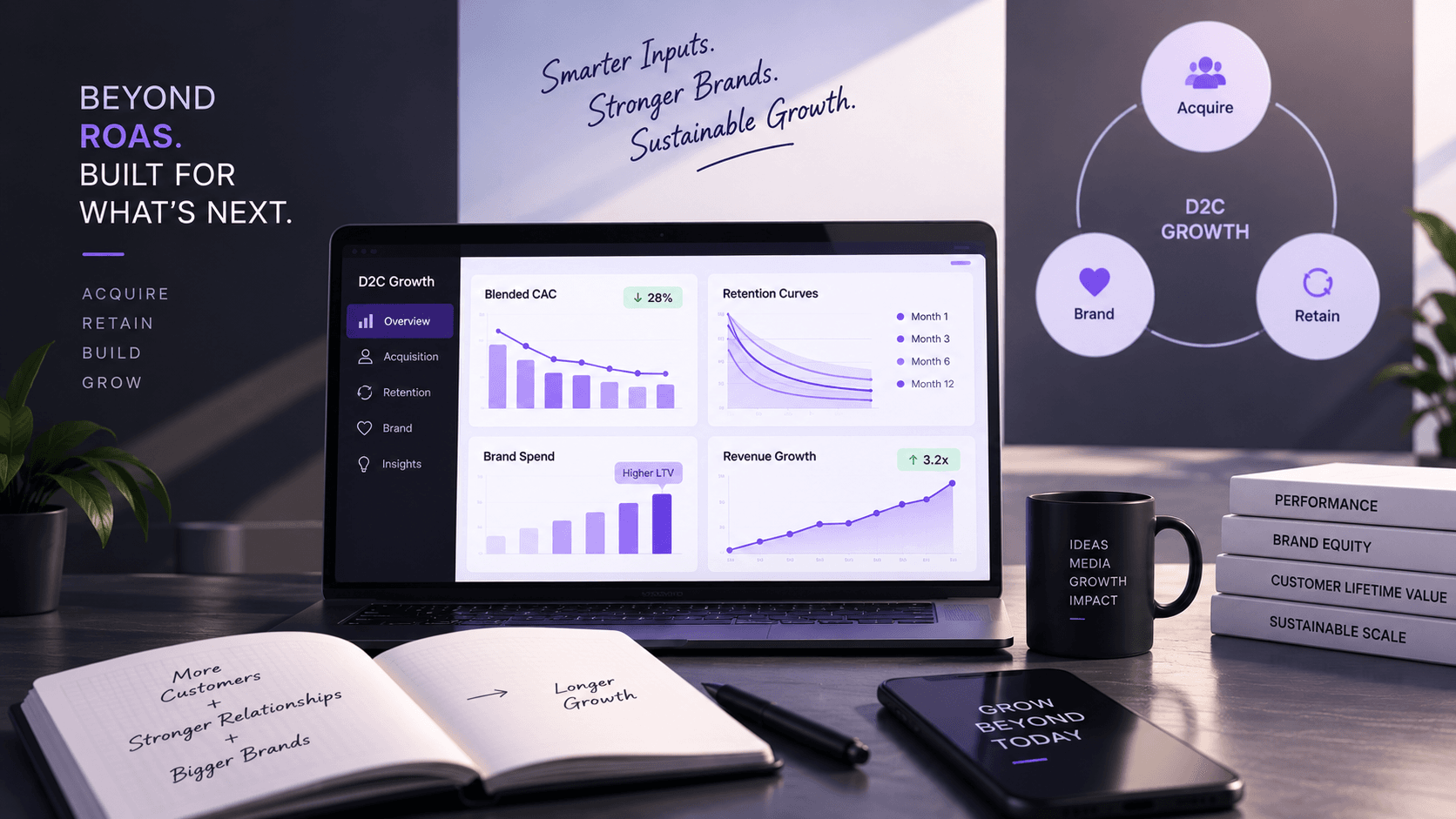
D2C growth in 2026 requires looking beyond ROAS. Brands that rely only on platform-reported returns can miss the bigger picture of acquisition costs, customer retention, and the long-term impact of brand investment. This guide explores how blended CAC, retention curves, and smarter brand spend timing help D2C companies build sustainable growth and make better marketing decisions.
ROAS is one of the most useful numbers in D2C marketing. It's also one of the easiest to read the wrong way.
A campaign can post a clean 4x ROAS and still be quietly propping up a weak business. Another can sit at 1.8x and be exactly what your brand needs to scale. The whole difference lives in what happens after that first purchase, which is the part most dashboards never show you.
For D2C brands, growth isn't just about buying customers cheaply. It's about acquiring them at a sensible cost, keeping enough of them around, growing their value over time, and knowing when brand investment should support performance instead of fighting it for budget. That calls for a different kind of D2C marketing strategy, one that treats performance creative, paid acquisition, CRM, email, retention, and brand as a single system with blended economics at the center, the same way Zero Theory approaches D2C growth rather than judging each platform in isolation.
So the real question for 2026 isn't "which campaign has the best ROAS?" It's "what's the healthiest acquisition and retention system we can actually scale?"
Why platform ROAS is not the full picture
Picture two campaigns, both spending ₹1,00,000. Campaign A brings back ₹4,00,000 in attributed revenue, a tidy 4x. Campaign B brings back ₹2,20,000, a modest 2.2x. On paper, you'd kill Campaign B before lunch.
Now add the part the platform doesn't tell you. Campaign A's customers almost never buy again. Campaign B's customers come back regularly, spend more per order, and actually respond to your CRM. Suddenly the "loser" looks like your best asset. Campaign A was probably harvesting demand that already existed. Campaign B was going out and finding better customers.
That's exactly why D2C brands need to shift from channel ROAS to blended economics. The platform view rewards whoever grabs the last click, not whoever builds the business.
What blended CAC actually tells you
Blended CAC answers a simpler, more honest question: how much did the whole business spend to bring in one new customer? The rough formula is total acquisition and marketing spend divided by new customers acquired.
The beauty of it is that you stop judging whether Meta or Google "deserves" the credit and start asking what the business is really paying to grow. It cuts through a lot of the false precision that platform attribution creates, and it tends to surface uncomfortable truths.
If Meta swears your CAC is ₹600 but your blended CAC is ₹1,400, something is happening in the gap between the ad account and the bank account. Maybe paid media is quietly influencing your organic demand. Maybe retargeting is taking credit for people who were already buying. Maybe you're reactivating existing customers, or brand campaigns are creating demand that performance then scoops up. Maybe attribution is just incomplete, or discounts are hiding weak unit economics.
Blended CAC won't fix your attribution model. What it does is force you to look at the number that actually matters at the business level, which is usually the one everyone's been avoiding.
CAC becomes meaningful only when paired with retention
CAC on its own tells you the cost of acquisition. Retention tells you what you actually bought.
Compare two brands. Brand A has a CAC of ₹1,000, first-order contribution of ₹1,100, and an 8% repeat rate at 60 days. Brand B has a higher CAC of ₹1,400, a lower first-order contribution of ₹900, and a 35% repeat rate at 60 days. If you only stare at first-order efficiency, Brand A wins easily. Look a few months out, and Brand B is very likely the stronger business. That's the whole case for taking retention curves seriously.
What is a retention curve?
A retention curve simply shows how many customers keep buying or stay active as time passes. For a subscription brand you might track months 1, 2, 3, 6, and 12. For ecommerce it's usually 30, 60, 90, 180, and 365 days.
The shape is where the story is. A sharp early drop that then flattens out is a very different animal from a slow, steady decline. A brand with a shaky first 30 days but solid six-month retention might have an onboarding or replenishment gap. A brand with a strong first month that falls apart after month three probably has a product-cadence problem. Marketing can't fix every one of these on its own, but it absolutely needs to know which one it's dealing with before it spends another rupee scaling acquisition.
Your best acquisition channel may be the one that creates the best retention curve
This is where D2C marketing gets genuinely interesting. Say your sources are Meta, Google, influencers, organic search, affiliates, creator partnerships, and direct traffic. Don't just line them up by CAC. Line them up by cohort.
For each source, follow the full path: CAC, then first order, second order, third order, contribution margin, and finally lifetime value. You'll often be surprised. Influencers might carry a higher first-order CAC but produce noticeably stronger retention. Paid search might deliver cheap customers who are hooked on discounts. Meta might bring scale with a mixed retention profile. Organic might have the lowest CAC of all but simply can't deliver the volume you need. Once you can see that, your budget decisions stop being guesses.
Brand spend should not be treated as the enemy of performance
One of the most exhausting habits inside D2C teams is the standing war between brand and performance. The brand wants a budget. Performance wants a budget. Finance wants to know which one converts. And around it goes.
Here's the calmer truth: they usually do different jobs. Performance captures demand that already exists and gives you measurable acquisition. Brand raises the odds that demand exists at all, keeps you top of mind, and quietly improves your conversion economics over time. Judge brand purely on same-day ROAS and it will always look like it's losing. Judge performance purely on long-term brand lift and accountability vanishes. The fix isn't picking a winner. It's sequencing the two.
When should a D2C brand increase brand spend?
There's no magic percentage, so watch for signals instead. The first is saturation: when more performance spend keeps producing worse marginal returns, you're likely hitting the ceiling of demand you can capture. The second is rising branded search, which can hint that more people know who you are, though it's a supporting clue, not proof. The third is growing direct traffic, again useful as part of a bigger picture rather than a verdict on its own. The fourth is creative fatigue, where you're refreshing ads constantly just to hold your baseline, a sign the demand system needs broader support. And the fifth is strong retention economics: when repeat behaviour is healthy, you can usually justify spending more aggressively to acquire customers whose value keeps compounding.
The D2C growth equation is not ROAS
A more honest mental model looks like this: Growth = Acquisition × Conversion × Retention × Customer Value. When one part breaks, pushing harder on another just multiplies the waste. More traffic with poor conversion is an expensive disappointment. More acquisition with poor retention is a leaky bucket. More discounts on weak margins is fake growth. More spending against saturated demand is just a deteriorating CAC. That's precisely why a serious strategy wires paid media to CRM, creative, site experience, merchandising, and retention instead of running them as separate vendor functions that quietly leak into each other.
Creative is the bridge between brand and performance
The old split said brand creative is emotional and performance creative is promotional. That line is getting less useful by the month, because a strong D2C creative system can do both at once. A single asset can build product memory, show the product in action, land your differentiation, answer objections, create urgency, and drive the conversion.
So the useful question isn't whether a piece of creativity is "brand" or "performance." It's what job this specific asset is built to do. That reframing makes testing smarter too. Instead of only asking which image earns a cheaper click, you start asking which message converts better, which hook pulls in higher-value customers, which proposition reduces discount dependence, which creative leads to stronger repeat behaviour, and which audience responds to which promise.
CRM is where profitable D2C growth often compounds
Acquisition gets the customer through the door. CRM decides what happens after. A serious lifecycle system usually runs a welcome flow to set expectations, first-purchase education so people actually succeed with the product, replenishment reminders timed to reorder cycles, cross-sell for complementary products, win-back for customers who've gone quiet, loyalty to reward your best buyers, and referral to turn happy customers into a new acquisition channel.
This is the piece that proves D2C growth can't be reduced to media buying. The acquisition team can create demand all day, but the lifecycle system is what turns that demand into real customer value.
Stop optimizing every channel independently
You know the meeting. Meta says ROAS improved. Google says ROAS improved. Email says revenue is up. Organic says traffic is up. Then the CEO asks what happened to the business, and the room goes quiet. That's not a performance problem, it's a measurement problem, and it's exactly why Zero Theory's approach connects channels, attribution, CRM, and revenue visibility inside one AI-first system rather than letting each channel grade its own homework.
The fix is a shared business dashboard: total marketing spend, new customers, blended CAC, first-order contribution, repeat purchase rate, cohort retention, lifetime value, contribution margin, new versus returning revenue, paid versus organic revenue, brand search trends, and incremental growth wherever you can measure it. Now the question stops being "did Meta hit 3.7x?" and becomes "did the customers we bought create enough value to justify what we spent?" That second question is the one that actually runs a D2C business.
A practical D2C framework for 2026
Work it in sequence. First, establish a blended CAC so you know what the business truly pays per customer. Second, build retention curves to see value over time. Third, segment your acquisition cohorts by source, campaign, creative, product, and audience. Fourth, measure contribution, not just revenue, because the top-line can look great while margins quietly erode. Fifth, spot demand saturation so you know when extra performance spend stops earning its keep. Sixth, fund brands strategically, where it can improve future acquisition economics. Seventh, connect CRM to turn first orders into repeat behaviour. And eighth, evaluate the whole system rather than letting every channel optimise for its own little dashboard. If you want help turning that into a live reporting setup, this is core to how an AI-first digital marketing agency ties spend to actual pipeline.
The D2C metric hierarchy
ROAS still earns a seat. It just belongs on the right shelf. At Level 1 you have platform metrics like CTR, CPC, CPM, and platform ROAS, which are great for optimisation. At Level 2 sit business acquisition metrics: blended CAC, new customer volume, and first-order contribution, which drive budget calls. Level 3 covers customer economics like retention, repeat rate, LTV, and contribution margin, which tell you the quality of your growth. And Level 4 is business growth: incremental revenue, profitable growth, and cash generation, the numbers leadership actually cares about. Climbing that ladder is how D2C marketing graduates from channel management to business management.
The real goal is not cheaper acquisition
It's better economics at scale. A brand that buys customers for ₹800 and can't keep them hasn't built a growth engine, it's built a treadmill. A brand that pays ₹1,300, retains those customers, grows their value, and can scale acquisition without wrecking contribution margin has the far stronger model.
The distinction is simple. ROAS measures what happened inside an ad platform. Blended CAC and retention tell you what happened to the business. In 2026, serious D2C marketers need both, because the next leg of growth won't come from squeezing another 5% out of a dashboard. It'll come from understanding how acquisition, retention, brand demand, creative, CRM, and customer economics feed each other, and then putting money where the whole system gets stronger. That's the D2C marketing strategy actually worth scaling.