AI marketing
Lead Scoring & Routing With AI: From Form Fill to Sales Call in 5 Minutes
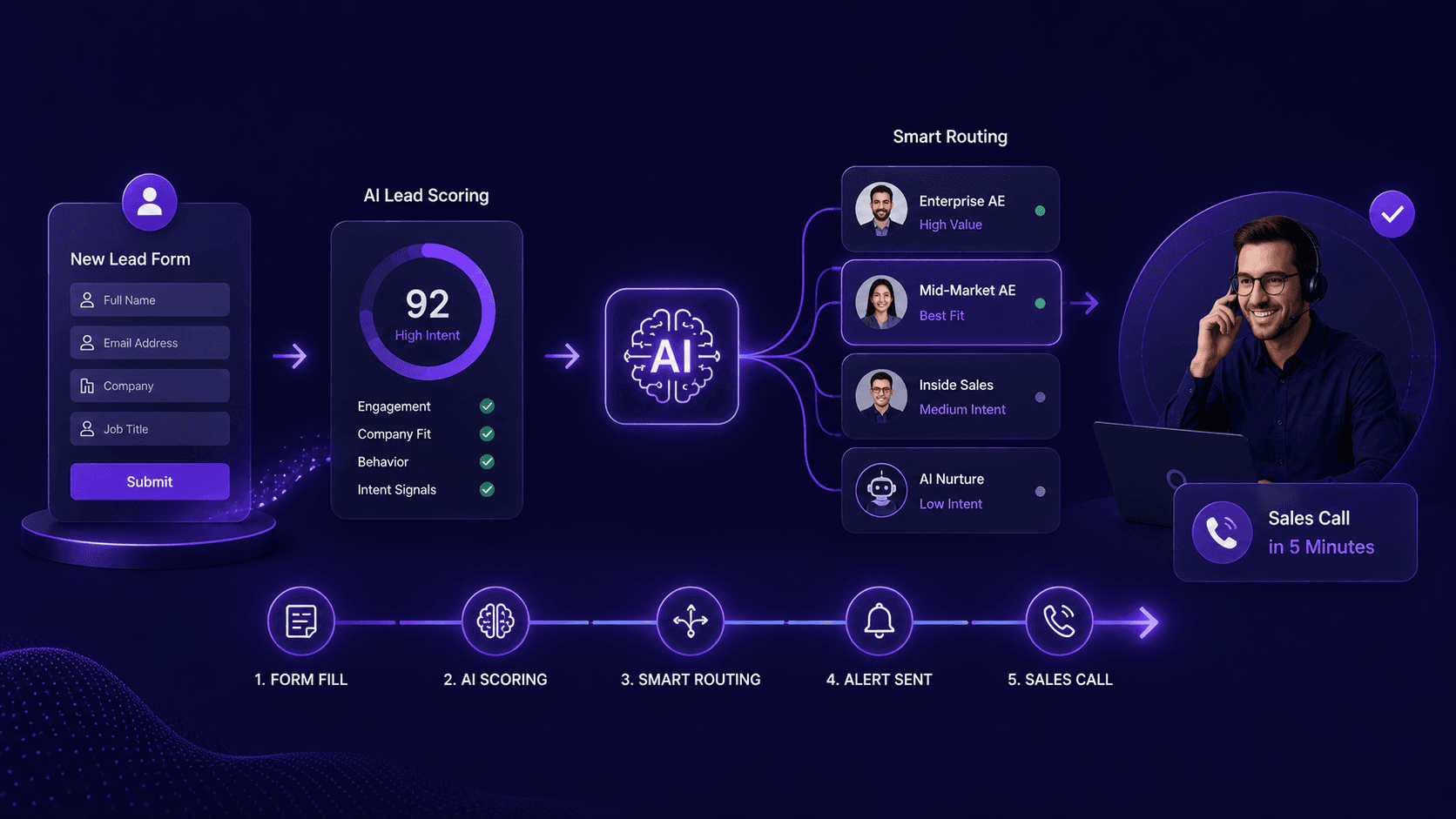
A form fill is only valuable when the right lead reaches the right salesperson quickly. AI-powered lead scoring and routing can evaluate intent, company data, behaviour, and form responses in real time, then trigger the right CRM workflow and sales handoff. This guide explains how to build a faster lead-to-sales process without sacrificing qualification or human oversight.
A prospect fills out your form at 10:03 a.m.
They're interested in your product. Right job title, right company size, right market. They've probably been researching you for days before they finally raised their hand.
And then, nothing happens.
The form lands in an email inbox. Someone spots it at 10:47. The lead gets copied into the CRM by hand. A rep gets assigned. The rep calls at 11:30. The prospect is in a meeting. By the time the two of them finally connect, the moment has passed and a competitor answered first.
This is one of the most expensive gaps in modern marketing, and it has nothing to do with lead quality. The lead was good. The handoff was slow.
AI lead scoring and routing exists to close exactly this gap. The objective is simple: when the right person raises their hand, the system should recognise the signal, qualify it, route it and trigger the next action almost immediately.
It's the first workflow we build in most of our AI marketing automation engagements at Zero Theory, and it follows our standard approach: start with one workflow, prove the ROI, then scale. But there's a distinction worth making before the mechanics. AI lead scoring isn't about stamping every lead with a mysterious number. It's about turning messy signals into fast, useful decisions.
Why Lead Response Time Matters
A prospect's intent isn't a constant. It decays.
Someone who just searched for your solution and completed a high-intent form is in a completely different state from someone who downloaded a general industry report three months ago. The first person is thinking about the problem right now. Tomorrow they'll be thinking about something else.
Picture two businesses receiving the same lead. Company A responds in five minutes. Company B responds the next day. Identical product, equally capable sales teams. Company A wins more often, simply because it entered the conversation while the buyer was still in it.
AI can't create demand. What it can do, ruthlessly well, is shrink the time between the demand signal and the sales response. That's the whole pitch.
What Happens After a Form Fill?
A single form submission quietly creates a dozen tasks. Someone has to capture the lead, validate the data, identify the company, understand the person's role, judge their intent, check ICP fit, assign a score, route it, notify sales, trigger follow-up and record all of it in the CRM.
Run those steps manually and two things are guaranteed: delays and errors. Connect them with AI and automation and the whole chain runs in seconds. Here's the sequence.
Step 1: Capture the Lead
The process starts the instant the form is submitted. The system should grab everything: name, email, company, job title, phone, product interest, form answers, landing page, campaign, source, UTM parameters, timestamp.
Sounds basic. It's where most operations quietly fail. If the lead enters the CRM without campaign and landing page context, your attribution is already weakened, and if the rep can't see what the prospect was looking at, the first call opens with "so, tell me about your needs," which is how you sound like everyone else.
Step 2: Enrich the Lead
Forms rarely give you enough. "John," company "ABC," title "Marketing" is not a qualification, it's a shrug.
AI-assisted enrichment fills the gaps: company size, industry, website, geography, role seniority, product category, likely account fit. The aim isn't hoarding data. It's collecting exactly the data that improves the next decision, and nothing that doesn't.
Step 3: Determine Intent
This is where AI starts earning its keep.
Intent is spread across signals no single field captures. A visitor who read the pricing page, viewed a case study, came back three times, downloaded the implementation docs and then filled the demo form is behaving very differently from someone who read one blog post and grabbed a broad industry guide.
Both are technically "leads." They absolutely should not get the same treatment. AI's advantage is reading those signals together, at the moment the form arrives, not in next week's list review.
Step 4: Score the Lead
A working scoring model weighs a handful of things. Fit: does the company match the ICP? Seniority: does this person influence the buying decision? Intent: is the behaviour buying behaviour? Engagement: how deep has the interaction gone? Timing: any evidence of immediate need? Product interest: what are they actually asking about?
The model turns those into a score. And this is precisely where most companies then make the classic mistake.
Don't Treat the Score as the Decision
A score is only useful if it changes what happens next.
A lead comes in at 87 out of 100. So what? If nothing different happens, the score is just another CRM field nobody reads.
A useful system attaches an action to every band. High score: immediate sales routing. Medium: automated nurture. Low: educational content. Existing customer: customer success. Partner lead: partner team. Now the score is operational, and the model is doing work instead of decoration.
AI Lead Routing: Getting the Lead to the Right Person
Routing gets underestimated because it sounds like an admin. It isn't.
Say you run enterprise sales, SMB sales, regional teams, product specialists and industry specialists. Sending every lead to "next available rep" wastes the best leads on the wrong conversations. The lead should go to the person most capable of winning it, decided by territory, company size, industry, product, account ownership, score, language and current capacity.
Automation handles all of that in under a second, without the Slack thread about whose lead it is.
Why the Five-Minute Goal Matters
The five-minute idea isn't a claim that every lead deserves a call in exactly 300 seconds. It's a design principle: no unnecessary operational delay anywhere in the chain.
A real workflow reads like this. 10:03, form submitted. 10:03:05, CRM record created. 10:03:10, enriched. 10:03:20, intent classified. 10:03:25, scored. 10:03:30, routed. 10:03:35, sales notified. 10:04, automated acknowledgement to the prospect. 10:05, rep on the phone.
The technology isn't the impressive part. The impressive part is that the waiting is gone.
AI Lead Scoring Needs Good Definitions
Here's the mistake that kills more scoring projects than any technical failure: building the model before defining a qualified lead.
Ask sales what makes a lead valuable. Ask marketing which signals are visible before the sales conversation. The two answers will disagree, and that disagreement is the useful part, because it forces the definition into the open.
Sales might insist on companies over 500 employees. Marketing's data might show smaller companies close at twice the rate. Neither side wins by seniority. The assumption gets tested against actual revenue data, and the data decides. This definitional fight is the same one that makes funnels leak between vendors when it never gets resolved.
Connect Marketing Data With CRM Outcomes
This is where AI scoring goes from useful to genuinely powerful.
Once the CRM holds lead source, campaign, score, response time, meetings, opportunities and closed revenue in one chain, you can ask the only question that matters: which signals actually predict revenue?
The answers surprise people. Job title matters less than everyone assumed. A pricing-page visit turns out to be extremely predictive. One specific form answer is the strongest buying signal in the account. One campaign delivers low volume and unusually high close rates. Now the model evolves from evidence instead of committee opinion.
Static Lead Scoring vs Adaptive Scoring
Traditional scoring runs on fixed rules. Job title, plus ten. Company over 500 people, plus twenty. Pricing page, plus fifteen. Demo form, plus thirty.
It works, until it doesn't, because markets shift, behaviour shifts, products and campaigns change, and the rules quietly go stale. AI keeps checking which signals still matter, which makes the model adaptive rather than archaeological.
Human oversight stays in the loop, though. A model might find that visitors to one particular page convert more often. Interesting. But maybe that page just sits late in the buying journey, so the correlation is a symptom, not a lever. The pattern is the machine's job. The interpretation is still yours.
Lead Routing Should Also Consider Capacity
Fit isn't the whole routing story. Availability is the other half.
One rep is sitting on 80 active opportunities. Another has 20. Pushing every new lead to the first rep because the territory says so creates a bottleneck with a name. Smarter routing weighs ownership, territory, expertise and lead value against current workload and availability. The result is a balanced sales floor and hot leads that don't queue behind a busy calendar.
What Should Happen After Routing?
Routing is the middle of the workflow, not the end.
When the lead reaches sales, automation keeps working. The rep gets a notification with substance: "New high-intent lead from ABC Corp. Requested demo. Viewed pricing twice." A CRM task fires: call within ten minutes. The prospect gets an acknowledgement so the silence doesn't stretch. And the rep sees the full context, source, campaign, pages viewed, form answers, company details, past interactions, before dialling.
The salesperson never starts from zero. That alone changes the quality of the first conversation.
AI Can Also Summarise the Lead
Nobody should read fifteen CRM fields before a call. AI can compress them:
"Marketing Director at a 750-person SaaS company. Submitted demo request after viewing pricing and integration pages. Previously downloaded the enterprise implementation guide. Primary interest appears to be CRM automation."
Thirty seconds of reading, full context. One rule though: every line of that summary must trace back to actual data. AI must never invent intent the evidence doesn't support, because a confident hallucination in a sales briefing is worse than a blank field.
What About False Positives?
No scoring system is perfect, and pretending otherwise sets the project up to be judged unfairly.
Some high-scoring leads won't buy. Some low-scoring leads will become your best customers. Normal. The objective was never a perfect prediction. It's better prioritisation than what you have now, and if the current process treats every lead identically, even a moderately accurate model is a big win.
Human Oversight Still Matters
Build the override from day one.
A rep should be able to flag a wrong score, wrong routing, a strategic account, an existing relationship, a special case, and that feedback should flow back into the system. AI scores, human reviews, outcome recorded, model improves. That loop beats pretending the machine will always be right, and it keeps sales invested in the system instead of working around it.
Don't Automate Bad Lead Generation
One hard truth before the architecture: AI routing cannot fix poor acquisition.
If paid media is generating irrelevant leads, better routing just delivers irrelevant leads faster. The fix is connecting acquisition quality to CRM outcomes, so the paid media machine optimises toward customers, not form fills. The real system is Campaign → Lead → Qualification → Routing → Sales → Opportunity → Revenue. Not Campaign → Form Fill → celebration.
Lead Scoring Can Also Improve Marketing
The feedback runs both directions, and the marketing side is the one people forget.
Suppose the system learns that high-value customers consistently read implementation content, visit pricing, come from a particular industry and engage with one specific webinar. That's a gift. It reshapes content priorities, paid targeting, landing pages, email, SEO and sales enablement all at once.
Sales outcomes improve marketing. Marketing signals improve sales. That's what a connected marketing system actually looks like in operation.
Common AI Lead Scoring Mistakes
Six we see repeatedly. Scoring everything, as if more data automatically meant better decisions. Never reviewing the model after launch, so it slowly optimises for a market that no longer exists. Ignoring sales feedback, when the people talking to prospects know things no dashboard shows. Optimising for lead volume, when more leads plainly don't mean more revenue. Routing on geography alone, ignoring expertise, account value and capacity. And automating routing without measuring response time, so nobody can say whether any of it worked.
What Should You Measure?
The honest scoreboard: lead response time, MQL-to-SQL conversion, meeting-booking rate, opportunity conversion, sales acceptance rate, lead-to-revenue conversion, revenue by source, routing accuracy, lead quality and hours saved.
Which one matters most depends on your business. But the governing question is never "how many leads did the system process?" It's "did the system help us turn more qualified demand into revenue?" Everything else is activity.
A Practical Five-Minute Architecture
The good news: this doesn't require an enormous AI infrastructure project.
The working stack is a chain. Form and website capture the signal. The CRM creates the record. An enrichment layer adds company context. AI qualification evaluates fit and intent. The scoring engine assigns priority. Routing logic picks the owner. Sales gets notified. Automated follow-up confirms the request and starts the right journey. The CRM records meetings, opportunities and revenue. Analytics measures what actually worked.
Ten links, mostly built from tools you already own. Enough to change the economics of your inbound funnel without a six-month build.
Start With One Workflow
The last principle, and the one we insist on with every client: don't automate the whole revenue operation at once.
Pick one workflow. Inbound demo requests are the usual best candidate. Measure the current state honestly: how long does response take, how many leads get contacted, how many become meetings, where do the delays live. Automate the highest-friction steps. Measure again. If it works, and it usually does, expand to the next workflow.
That's our whole automation philosophy at Zero Theory: one workflow, proven ROI, then scale what works. It's slower than buying a platform and vastly faster than living with a 44-minute inbox.
Conclusion
The most valuable thing about AI lead scoring isn't the score. It's the speed and consistency of the decision that follows it.
A prospect raises their hand. The system reads the signal, enriches the lead, notifies the right person, records the context, and sales responds while intent is still hot. The outcome then feeds back into marketing. Compare that with form → spreadsheet → email → someone eventually calls, and the gap is the revenue you're currently leaving on the table.
Technology is half the equation. You still need a clear ICP, an agreed definition of qualified, reliable CRM data, working attribution, sensible routing rules, sales feedback, human oversight and revenue measurement. Get those right and lead scoring stops being a marketing automation feature and becomes part of a revenue operating system.
That's where the real value sits. If your leads are currently waiting 44 minutes in an inbox, book a free growth audit. We'll time your current form-to-call gap, show you where the minutes go, and hand you a written first move whether or not you work with us.