AI marketing
How AI Changed Paid Media Buying: What Still Needs a Human in 2026
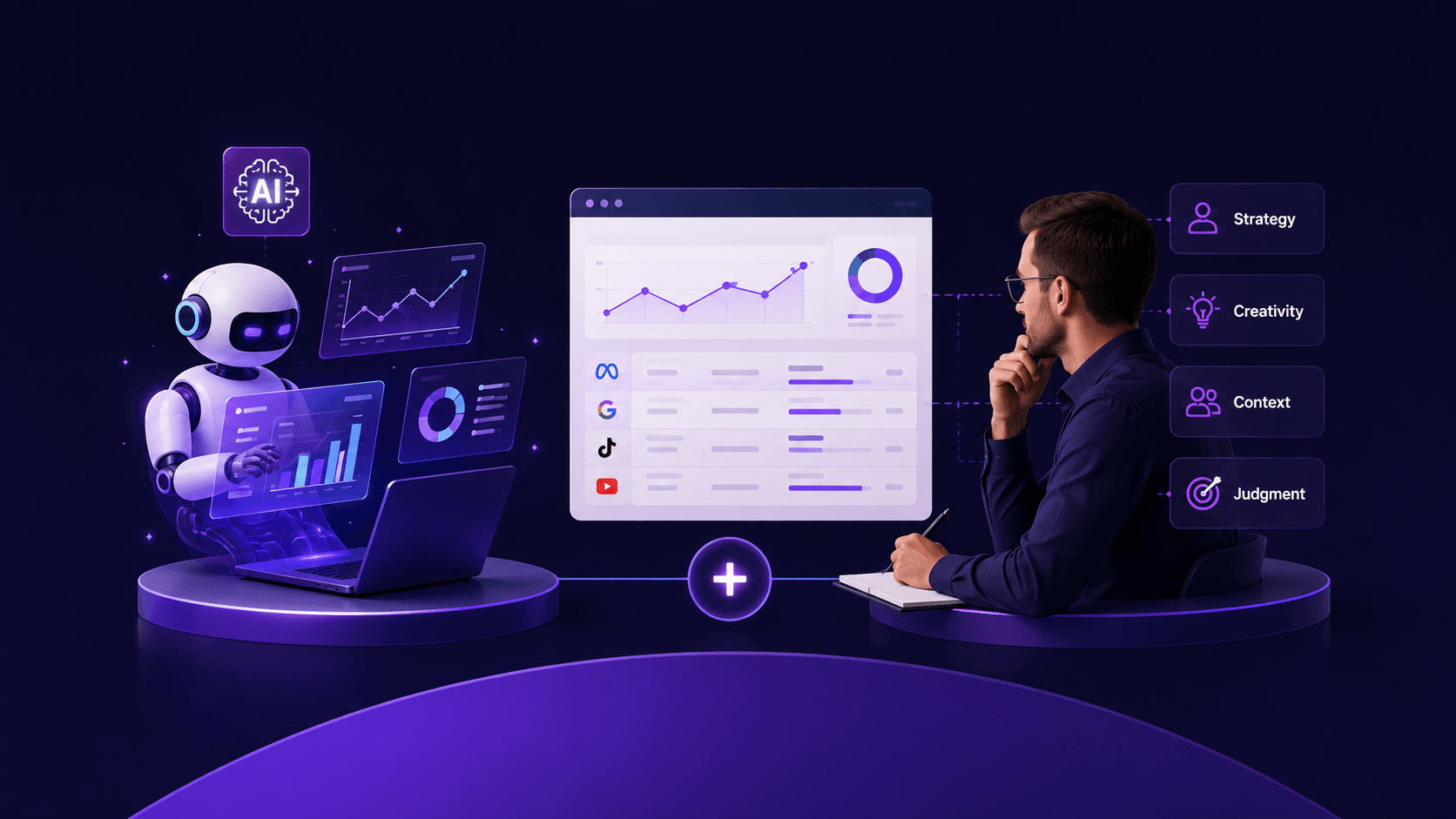
AI is changing paid media buying from manual campaign management to intelligent, data-driven optimisation. In 2026, automation can handle much of the bidding, targeting, testing, and performance analysis, but it cannot replace human judgement. This guide explores what AI can manage in paid media and where marketers still need to lead strategy, creative decisions, budget allocation, and growth direction.
Paid media used to reward a particular kind of marketer. The one who built the cleanest campaign structure, wrote the sharpest ad variations, adjusted bids at exactly the right moment and spent hours inside the platform hunting for small optimisation wins.
That world is mostly gone.
In 2026, Google, Meta and the other platforms automate a huge share of the work that once needed a specialist's hands on the controls. AI analyses signals, predicts behaviour, adjusts bids, generates creative variations, finds audiences, summarises performance and spots patterns across thousands of data points no human could inspect one at a time.
Which raises the obvious question: if AI can do this much of the buying, what's left for the human?
The answer is more interesting than "everything" or "nothing." AI has become the execution layer of paid media. Humans have become more important in exactly the places execution can't reach: strategy, positioning, judgement, creative direction, business context, offer design, and deciding what happens next.
That distinction matters, because the biggest mistake a marketer can make in 2026 is confusing automated media buying with automated marketing strategy. They are not the same thing, and treating them as the same is how budgets disappear efficiently.
It's also how we've built our own performance marketing practice at Zero Theory: campaigns optimised toward qualified leads and business outcomes rather than impressions and clicks, with senior humans keeping hold of strategy and judgement. That's the practical meaning of being an AI-first agency, and paid media is where the split shows most clearly.
Let's look at what has actually changed.
Paid Media Has Moved From Manual Optimisation to Machine-Led Buying
There was a time when a PPC manager's day was a long list of manual jobs. Adjusting keyword bids. Reviewing search terms. Building audience segments. Shuffling budget between campaigns. Writing ad variations. Growing negative keyword lists. Checking device and location performance. Watching hourly numbers. Assembling reports by hand.
Most of that is now automated, and honestly, good riddance.
The platforms sit on enormous behavioural datasets. They evaluate device, location, time, search behaviour, past interactions, conversion history, audience signals, creative engagement, landing page behaviour and historical performance, per auction, in milliseconds. An algorithm processes those signals faster than any person ever will.
So the human advantage is no longer the speed of optimization. It's the quality of decision-making. That's the whole shift, and everything below follows from it.
What AI Is Already Doing Well in Paid Media
Bid Optimisation
Bidding is where machine learning changed PPC first and most completely.
A human looks at yesterday's conversion rate and nudges a bid. An automated system estimates the conversion probability of each individual auction across dozens of variables and prices it accordingly. It isn't always right. But manually adjusting bids is no longer the highest-value use of anyone's day.
The specialist's real job now sits one level up: deciding what we're actually optimising for. A cheap click? A form fill? A qualified lead? A sales opportunity? Revenue? Those are very different targets, and the machine will chase whichever one you point it at, including the wrong one.
Audience Identification
AI finds patterns in behaviour that a marketer would never spot by eye.
Two audience groups can look identical on the surface. Underneath, one produces lots of leads that never answer the phone; the other produces fewer leads and far more sales conversations. The machine can surface that behavioural difference.
But someone still has to decide whether the correlation matters commercially. Data identifies a pattern. Strategy decides whether the pattern deserves budget. Skip that second step and you'll scale a statistical accident.
Creative Variation
Generative AI has collapsed the cost of producing ad variations. Headlines, hooks, primary text, image concepts, video scripts, landing page copy, CTAs, all in a fraction of the old time.
Which creates a problem nobody advertises: when creative production gets cheap, bad creative gets cheap too. A hundred ad variations doesn't mean a hundred good ideas. It usually means a hundred versions of one mediocre idea, and the algorithm will dutifully test all of them.
That's exactly where human judgement got more valuable, not less.
AI Can Optimise the Campaign. It Cannot Fix a Bad Offer.
If you remember one thing from this piece, make it this one.
Take an ad with strong targeting, excellent optimisation, a healthy click-through rate and efficient bidding, sitting on top of a weak offer. AI will make the traffic more efficient. It cannot make an unattractive proposition attractive.
If the landing page confuses people, no bidding strategy optimises the confusion away. If the product has poor market fit, cheaper clicks just mean cheaper rejection. If the message is indistinguishable from three competitors, automation scales the indistinguishability.
Which is why paid media strategy still starts outside the ad platform, with questions and no algorithm answers. Who is this for? What problem are we solving? Why should someone care now? Why should they believe us? And why us instead of the other tab they have open?
What Still Needs a Human in 2026?
Positioning: AI will happily generate ten positioning statements. That doesn't make any of them strategically right.
Positioning needs market understanding: what competitors are saying, what customers actually care about, what the company can credibly own, what's genuinely different, what's commercially worth owning. A machine can help analyse all of that. A senior marketer has to decide what the brand stands for, because that decision carries consequences a model doesn't bear.
Offer Strategy: An ad is only as strong as the offer behind it.
Compare two campaigns. Campaign A: "Book a Free Consultation." Campaign B: "Get a 30-Minute Paid Media Waste Audit Showing Where Your Budget Is Leaking." The second gives someone a concrete reason to respond today. The difference isn't media buying. It's an offer strategy.
AI can generate and test offers all day. Deciding what promise the business is willing, and able, to keep is a human call, because a broken promise is a business problem, not a campaign problem.
Creative Direction: AI generates options. Humans still decide which ideas deserve to exist.
A good creative director recognises cultural relevance, brand fit, emotional tension, audience sophistication, category clichés, unexpected angles, weak claims and generic language, often in seconds, often by instinct built over years. The future of creative work isn't humans versus AI. It's human direction plus machine-scale production, and the teams that get that split right will simply out-create everyone else.
4. Interpreting Performance
A dashboard says cost per lead rose 28%. That's a fact, not an explanation.
Someone still has to ask why. Maybe the audience shifted. Maybe a competitor doubled spend. Maybe the offer has aged. Maybe lead quality improved and the higher CPL is actually good news. Maybe the landing page slowed down. Maybe sales stopped following up within the hour. Maybe the campaign produces fewer leads and more revenue.
Each explanation demands a different response, and picking the wrong one wastes a quarter. This is why we bang on about connecting ad platforms to CRM and building attribution executives will trust: interpretation is only as good as the data underneath it.
The Biggest Shift: Optimising for Revenue Instead of Clicks
AI makes optimisation at scale easy. Optimisation is only valuable when it's pointed at the right target.
A campaign can have excellent CTR, low CPC, cheap leads and a high conversion rate, and still lose money, because the leads are junk. We've audited accounts exactly like this. The dashboard was beautiful. The pipeline was empty.
The fix is connecting paid media to the CRM. Follow the journey: ad, landing page, form, CRM, qualification, sales call, opportunity, customer. If the platform only sees the form submission, it optimises for form submissions, and it will find you the people most likely to fill forms, not the people most likely to buy.
Feed downstream signals back into acquisition and the question changes from "how do we get cheaper leads?" to "how do we acquire more customers at an acceptable cost?" That's a much better problem, and it's the difference between running a channel and running a marketing system.
AI Makes Testing Faster. Humans Decide What to Test.
Testing economics have changed too. Instead of launching one headline and waiting two weeks, you can generate and evaluate dozens of variations quickly.
But testing everything isn't learning. Learning needs a hypothesis.
For example: enterprise buyers respond better to risk-reduction messaging than productivity messaging. Now the team builds creative around that specific bet. If it wins, the insight doesn't stay in the ad account. It flows into landing pages, website copy, sales enablement, email and content. The test stops being an ad experiment and becomes a market-learning exercise, which is worth ten times more than the CTR improvement.
The Human Role Is Moving Up the Stack
This is probably the biggest change AI is creating in paid media, and it's a good one if you're willing to move with it.
The human role is leaving repetitive execution behind. Instead of "which campaign should I adjust today?", the better question is "why are customers choosing this?" Instead of "which ad has the highest CTR?", ask "which message is attracting the right buyers?" Instead of "how do we reduce CPL?", ask "how do we increase qualified pipeline from the same spend?"
AI doesn't eliminate those questions. It makes them do the whole job.
What an AI-First Paid Media Workflow Looks Like
Here's how the system runs in practice, and who owns each step.
Step 1: Human defines the business objective. Qualified pipeline, new customers, revenue, product trials, high-value appointments. Pick one.
Step 2: AI analyses historical data. Patterns across campaigns, audiences, creative, landing pages and CRM outcomes.
Step 3: Human defines hypotheses. The strategist decides which patterns are worth betting on.
Step 4: AI generates variations. Creative and copy production at machine speed.
Step 5: Platforms automate delivery. Bidding, audience selection and placement at scale.
Step 6: AI monitors anomalies. Flags unusual moves in conversion rate, lead quality, spend, CPA, revenue and funnel performance before a human would have noticed.
Step 7: Humans interpret the signal. What does the change actually mean, and what should we do?
Step 8: Insights move across the marketing system. A real insight influences content, SEO, landing pages, CRM, email and sales, not just the next ad set. That last step is the one most teams skip, and it's where paid media stops being an isolated channel and starts feeding the whole automation stack.
Where Marketers Should Be Careful With AI
A few honest risks, from accounts we've inherited.
Over-automation: When everything is automated, nobody can explain why campaigns behave the way they do, and debugging becomes archaeology.
Weak creative differentiation: Generative tools default to sounding like everyone else, because that's what they were trained on.
Bad data: AI trained on poor conversion data optimises confidently toward poor outcomes.
Attribution errors: Disconnect the CRM from the ad platforms and the optimisation target quietly becomes wrong.
Brand inconsistency: Automated creative drifts from positioning one variation at a time.
False confidence: An AI-generated explanation sounds convincing even when the conclusion underneath it is wrong. Fluency is not accuracy.
None of these are reasons to avoid AI: All of them are reasons to design human oversight into the system rather than bolting it on after the first expensive mistake.
The Best Paid Media Teams Will Not Be the Ones Using the Most AI
They'll be the ones using it at the right points.
Automate what's repetitive, high-volume, rules-based, data-heavy and easy to measure. Keep humans close to what needs judgement, context, creativity, strategy, risk assessment, brand understanding and commercial decision-making.
That division was fuzzy in 2023. In 2026 it's becoming sharp, and it's one of the questions worth asking any agency you're evaluating: where exactly do their machines stop and their people start?
Conclusion
AI has changed paid media buying, permanently. Nobody is going back to manually adjusting dozens of settings a day, and nobody should want to.
But that hasn't made strategy less important. It's made it decisive. When every competitor's machine can optimize at enormous scale, the advantage belongs to the organisation that knows what should be optimised in the first place.
The strongest teams will use AI to analyse more data, produce more creativity, test faster, automate operations, catch anomalies, sharpen attribution and connect signals across the system. Humans will keep owning positioning, offer strategy, creative direction, business context, prioritisation, interpretation and accountability.
The future of paid media isn't human versus AI. It's humans deciding what matters, and AI executing it at a scale no human team could manage alone.
If you want to see where your own paid media sits on that line, and where budget is leaking between the machine and the strategy, book a free growth audit. Thirty minutes, and you'll leave with a written first move whether or not you work with us.