AI marketing
What Is llms.txt and Should Your Website Have One?
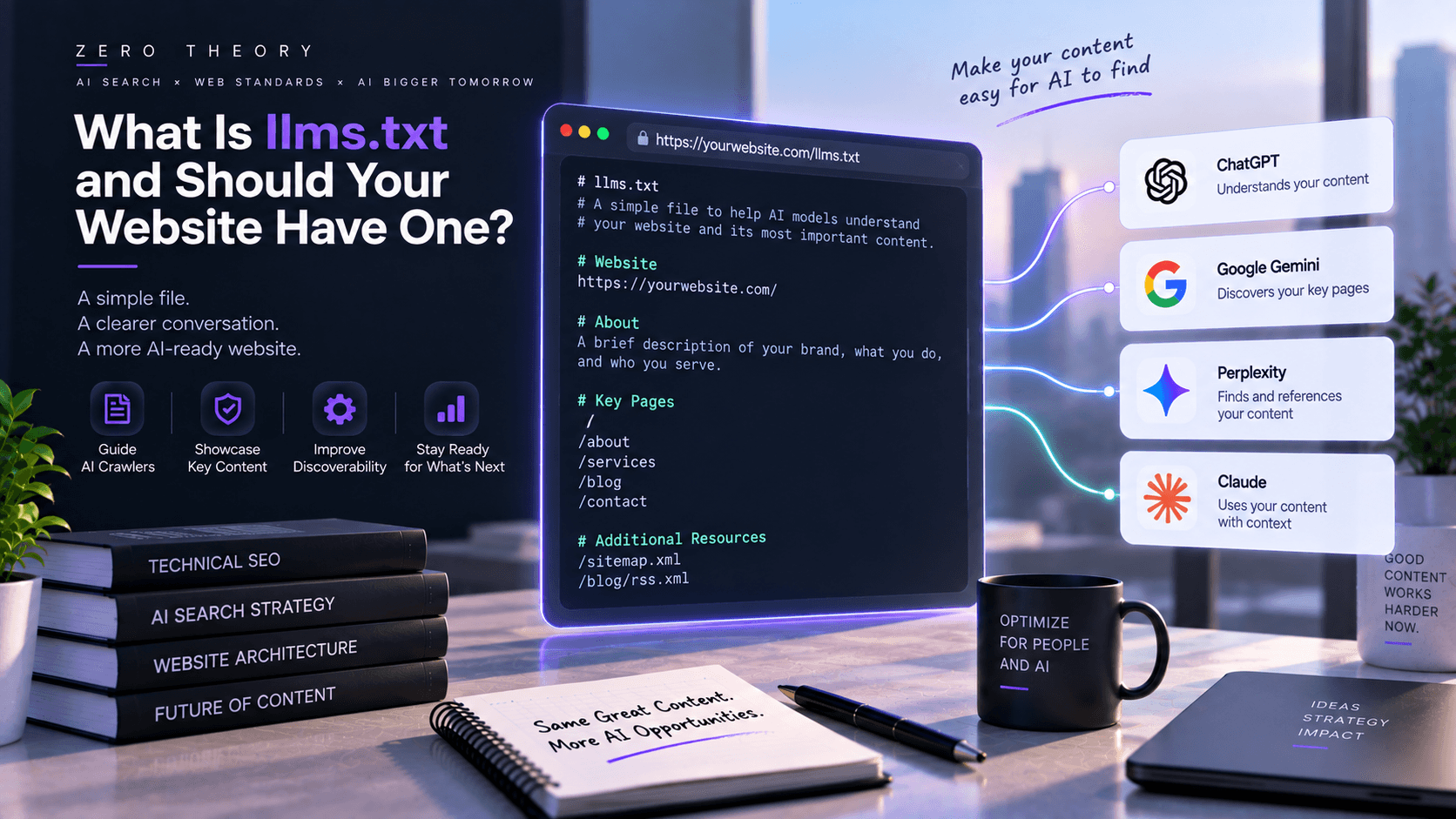
As AI search and generative tools become more important for online discovery, website owners are exploring new ways to make their content easier for AI systems to understand. This guide explains what llms.txt is, how it differs from robots.txt and sitemaps, what it can be used for, and whether adding an llms.txt file makes sense for your website.
Few technical topics in AI search have caused as much confusion as llms.txt. Some marketers call it the robots.txt for AI. Others claim every website needs one to appear in ChatGPT. Others treat it as a major GEO ranking signal.
The reality is far less dramatic. llms.txt is a proposed Markdown file meant to give AI systems a curated overview of a website's important content. The idea is sensible, but that doesn't make it a major AI-search ranking factor. A cautious position is the right one: llms.txt may have useful applications for AI coding agents and technical documentation, but businesses shouldn't treat it as the core of a GEO strategy, that role belongs to the fundamentals in the GEO pillar.
What llms.txt is, and what it isn't
An llms.txt file usually sits at the root of a site (example.com/llms.txt) and uses Markdown to give AI systems a curated description plus links to important resources. Instead of making an AI crawl thousands of pages to understand a site, the owner provides a concise map: "here are the pages you should know about." That sounds useful, but the real question is whether major AI search systems actually use it.
Critically, llms.txt is not robots.txt. Robots.txt is an established web standard telling crawlers which areas they can access. llms.txt is a proposed convention for helping AI understand important resources, it doesn't control crawling the same way, doesn't make content available to AI systems, and having the file doesn't guarantee any AI system will read or use it. On rankings, Google's guidance says websites don't need to create new machine-readable files or special AI text files to appear in its generative AI features, and that existing SEO best practices remain the foundation. So if someone sells "add llms.txt and your AI Overview visibility will jump," ask for evidence, a file can't compensate for poor content, weak authority, bad indexation, or inconsistent entities.
Does it help ChatGPT, and where does it actually make sense?
Don't confuse an llms.txt file with ChatGPT crawler access. OpenAI's publisher guidance says public sites can appear in ChatGPT Search and recommends allowing OAI-SearchBot if you want content discovered, surfaced, and cited, that's a concrete technical consideration, whereas llms.txt is optional. Crawler accessibility and llms.txt are not the same thing, a distinction the ChatGPT-specific GEO guide covers in detail.
The concept does address a real problem, though. Documentation-heavy sites can have hundreds of pages, API references, tutorials, guides, examples, changelogs, and deprecated docs, and an AI coding agent may only need the important resources. A curated file can make that discovery easier. So llms.txt can make sense for developer documentation, large documentation sites, technical knowledge bases, and agentic workflows. But potential utility is not the same as established search-ranking impact. For a typical agency, consultant, local business, ecommerce brand, SaaS marketing site, or professional-services company, priorities lie elsewhere: fix crawlability, indexation, site architecture, content quality, internal linking, structured data, entity consistency, and external authority first, then consider llms.txt.
Why content matters more, and the right priority order
Compare two sites. Website A has llms.txt but thin content, poor internal links, no original research, a weak brand identity, and limited authority. Website B has no llms.txt but excellent content, strong technical SEO, clear entities, original research, strong backlinks, and industry recognition. You'd take Website B every time. The lesson: don't confuse a machine-readable file with a strong information ecosystem. If you do create an llms.txt file, keep it useful, a company overview, links to key pages, documentation, products, services, and research, and keep it maintained, because a stale file is worse than a useful one. It also doesn't replace your sitemap (which helps engines discover URLs) or schema (which describes entities), they have different jobs.
A sensible technical GEO hierarchy runs: accessibility, then indexation, then information architecture, then content structure, then structured data, then entity consistency, then authority, and only then machine-readable extras like llms.txt. That order is far more useful than starting with emerging file formats. Google's guidance reinforces it: there are no additional technical requirements for AI Overviews or AI Mode beyond being indexed and eligible for Search, and you don't need special AI text files. That doesn't mean machine-readable formats have no future, it means you shouldn't confuse them with requirements.
Should every business create one?
No. Ask three questions: do you have substantial technical documentation (if yes, it may help)? Do AI coding agents or tools need to navigate your resources (if yes, consider it)? Are you doing it only because an agency says it will boost AI citations (if yes, investigate the evidence first)? The strongest argument for creating one anyway is future-proofing, AI agents are evolving, machine-readable navigation could become more useful, and the implementation cost is low, so for a large documentation site it can be a reasonable experiment. Just don't confuse an experiment with a strategy, and if you implement it, measure properly: record AI prompt visibility, mentions, citations, and search performance before and after, and if nothing changes, don't invent a success story.
So, should your website have an llms.txt file? Maybe. If you run technical documentation, APIs, or resources AI agents may need to navigate, it's worth considering. If you're a normal business hoping to improve ChatGPT, Gemini, Perplexity, or Google AI visibility, it belongs far down the list. First make the site accessible, the content useful, the brand understandable, the authority genuine, the entities consistent, and the answers real, then experiment with formats. A file can tell an AI where your important information is; it can't create the information, the authority, the expertise, or the trust. If you have twenty minutes, make one. If you have twenty hours for GEO, spend them on the things that actually make your brand worth finding.