AI marketing
How to Choose an AEO Agency for the AI Search Era
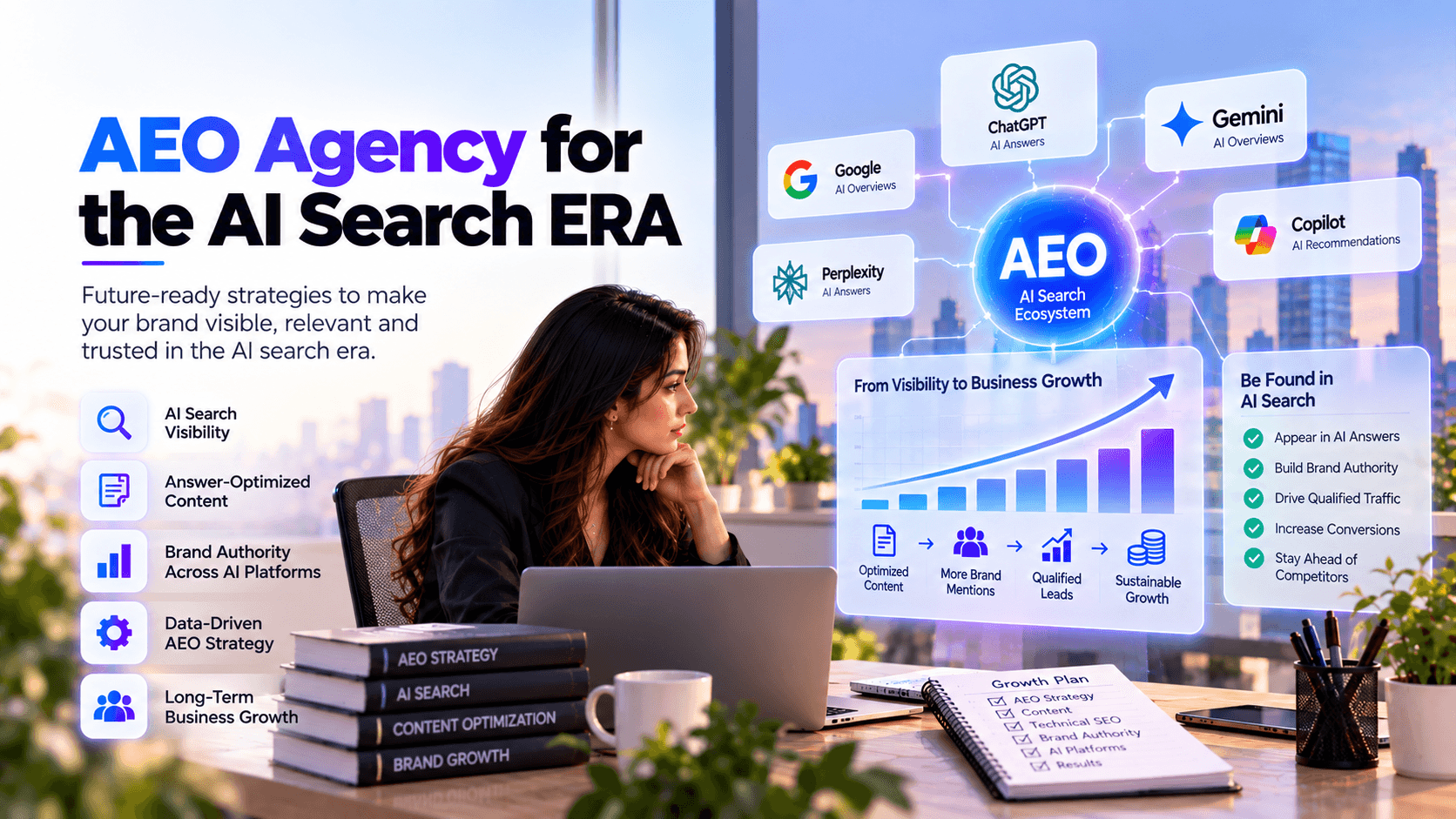
AI search is changing how customers discover brands, and choosing an AEO agency requires a different evaluation framework. This guide explains what to look for in an AEO partner, including answer-focused content, entity clarity, technical accessibility, structured data, AI citation tracking, and measurable search visibility.
Search is changing, and fast. People increasingly ask questions instead of typing keywords, and they expect direct answers, comparisons, and recommendations from AI-powered search rather than a list of ten blue links to sift through.
For businesses, that creates a new visibility problem. Ranking on Google still matters, but it's no longer the only question worth asking. The fuller question is: can potential customers discover, understand, and trust my brand when they search through AI-powered answer engines? That's where Answer Engine Optimization comes in. But as demand for AEO grows, so does a second problem: choosing the right agency to handle it. The market is filling up with firms offering AEO, GEO, AI SEO, and LLM optimization. Some have real search depth. Some have just bolted AI terminology onto their old SEO packages. Others lean entirely on content generation while ignoring technical SEO, entities, authority, and measurement. So the goal isn't to find whoever promises the most citations. It's to find an agency that can explain how your brand will become easier for answer engines to understand, retrieve, reference, and recommend, while still strengthening your broader organic presence.
What an AEO agency actually does
An AEO agency optimises your digital presence for answer-focused search. Traditional SEO mostly asks "what keyword should this page rank for?" AEO asks "what question is the customer actually asking, and how do we give them the clearest, most useful answer?" A real programme pulls together search-intent and question research, answer-focused content architecture, technical SEO, internal linking, structured information, entity optimisation, topical authority, brand mentions and digital PR, AI-search monitoring, competitor analysis, and reporting. The exact mix should depend on the business, a SaaS company, a healthcare provider, a fintech, and an ecommerce brand won't have identical requirements, and how an agency tailors that mix is one of the first things to judge. It's also worth understanding upfront how AEO differs from SEO and GEO, which the AEO explainer and the GEO vs SEO breakdown both cover.
Why choosing an AEO agency is different
The disciplines overlap heavily, and SEO fundamentals still decide a lot. A technically inaccessible website won't become a strong source just because an agency calls its strategy "AI-first." Content quality, search intent, authority, and internal linking all still matter. What AI search adds is a layer around how information gets understood, summarised, associated with entities, and presented as an answer. So look for an agency that genuinely understands both sides: SEO provides the foundation, AEO adds the answer-focused layer, and GEO extends the strategy toward generative-AI visibility. The strongest firms don't treat these as three isolated channels, and neither should you, which is the whole argument behind running SEO, GEO, AEO, and automation as one connected system.
Start with your business goal
Before you contact anyone, define what you actually want. "Get visibility in AI" is too vague to evaluate against. Pin it to a specific outcome instead: more visibility for informational questions, more brand mentions in recommendation-style queries, better commercial discovery when people research your category, stronger authority in a specific area of expertise, or AEO that complements an existing SEO programme rather than running off on its own. Once the goal is concrete, comparing agencies gets far easier.
The questions that separate a real strategy from a sales pitch
Do they have real SEO expertise?
This sounds obvious, but it's one of the most important checks. AEO doesn't exist in a vacuum, your site still has to be crawlable, indexable, well-structured, and internally connected. If an agency wants to optimize your AI visibility but can't explain how your website is crawled, indexed, structured, and linked, keep asking questions.
How do they define AEO?
"We create AI-friendly content" tells you nothing. A strong answer walks through how they handle user questions, search intent, direct answers, content structure, entities, topical authority, source credibility, brand visibility, technical accessibility, and measurement. There should be a real methodology behind the buzzword.
What's their audit process?
A good agency diagnoses before it prescribes. Expect a discovery or audit that examines whether important questions are answered on-site, whether content is easy to navigate, whether crawlers can reach key content, whether the brand is clearly defined across the web, what the wider web associates with the brand, whether the company shows genuine topical authority, which competitors appear for important questions, and where the brand currently shows up or fails to show up across AI search. Crucially, the audit should produce priorities, not a 70-page PDF nobody knows how to take.
Which AI platforms do they monitor, and why?
AI search isn't one platform. Depending on your audience it may span Google's AI search experiences, ChatGPT, Perplexity, Gemini, and industry-specific tools, and a B2B SaaS company has very different priorities from a local consumer brand. Don't accept "we optimize for all AI platforms." Ask which platforms matter for your customers and why, since that reveals whether they're building around your audience or selling a standard package. The platform-specific playbooks for ChatGPT and others are a useful benchmark for how deep an agency actually goes.
Content, originality, and entities
How do they decide what content to create?
Volume shouldn't be the pitch. A strong answer covers search intent, customer questions, content and competitor gaps, commercial priorities, topical clusters, original insight, first-hand expertise, evidence, content consolidation, and internal linking. Be wary if the whole proposal is "we'll publish 50 AI-written articles a month", more pages don't mean more authority, and a pile of repetitive, low-value content just makes a bigger website, not a stronger brand.
How do they make content original?
This matters more than ever, because AI churns out generic explanations in seconds, which makes generic content both easy to produce and easy to ignore. Ask what will make your content different from the other hundred sites covering the same topic. Look for customer interviews, expert commentary, original research, proprietary data, case studies, first-hand experience, and unique frameworks, the kind of thing an answer engine actually has a reason to cite, and exactly the discipline behind producing AI content without the slop.
What's their entity strategy?
One of the biggest shifts in AI-search work is treating your brand as an entity. The agency should understand how you're represented across your website, about and author pages, LinkedIn, directories, publications, reviews, partner sites, PR, and podcasts. If your site says "an AI-first B2B growth agency" but the wider web calls you "a traditional advertising agency," your identity is fragmented, and a good agency will spot that inconsistency and fix it. On authority, ask how they'll build it outside your own site through digital PR, expert contributions, publications, research, podcasts, and genuine editorial mentions, and be clear that the aim is earning visibility, not manufacturing fake mentions, a point explored in why brand mentions matter in AI answers.
Measurement, baselines, and the guarantees to avoid
How do they measure AEO?
"AI visibility improved" isn't a report. Ask exactly what they track: prompt coverage, brand mention rate, citation rate and position, competitor visibility, share of AI visibility, plus organic performance (rankings, impressions, traffic, conversions) and commercial impact (qualified leads and sales). A mature agency connects AI-search metrics back to business outcomes. And they should establish a baseline first, current brand and competitor visibility, citations, relevant pages, and organic performance, then re-measure periodically, because you can't prove progress without a starting point.
Be very careful with "guaranteed AI citations.
"This is a major red flag. No serious agency should promise ChatGPT will cite you or that you'll land in a Google AI Overview. AI results shift with query wording, location, context, available sources, and model updates. An agency can improve the conditions for visibility, not control the final generated answer. Replace "can you guarantee citations?" with "how do you measure and improve citation probability?" and you'll get a far more honest conversation.
People, integration, and pricing
AI can help with research, briefs, analysis, drafting, and automation, but AEO shouldn't become a content factory, so ask who actually owns strategy, research, editorial review, subject-matter accuracy, and performance analysis. Ask to see a sample report, and check it answers what changed, why, what worked, what didn't, and what's next, rather than burying you in charts. Industry experience helps too, since healthcare, fintech, SaaS, and ecommerce carry different trust and compliance considerations, so ask whether they've worked with similar customers and buying journeys. If you already have an SEO agency, ask how the AEO work will integrate, otherwise two teams can quietly compete for the same topics and pages. And on pricing, don't compare on monthly cost alone. Compare the strategy, audit depth, content quality, technical implementation, authority work, monitoring frequency, reporting, and senior involvement included. A lower price often just means fewer services; the real question is what business problem the engagement solves and what exactly gets delivered.
What a strong engagement looks like
A mature programme runs as a continuous cycle, not a one-off project: discovery to understand your business, audience, competitors, and goals; a baseline of current organic and AI-search visibility; an audit of technical SEO, content, entities, authority, and answer coverage; a strategy built around a priority question and content map; implementation that improves existing pages and creates high-value new content; authority-building through legitimate external references and expert visibility; measurement across AI visibility, organic performance, and commercial outcomes; and optimisation that feeds the next cycle. That structure beats "audit, then 100 blog posts" every time.
Above all, remember the durable strategy isn't a secret prompt or a technical trick. Platforms and models will keep changing, and anything built on a temporary loophole ages badly. What lasts is being useful, clear, specific, and authoritative, demonstrating real expertise, building genuine evidence, making your brand easy to understand, and answering the questions your customers actually ask. So don't start with "who promises the most AI citations?" Start with "who understands our customers, our search environment, our goals, and the information needed to make our brand discoverable and trustworthy?" The right AEO agency should be able to tell you where you are now, where the gaps are, which questions matter, what needs to change, how it'll be implemented, how progress is measured, and how that progress connects to revenue.