Insights
Best SEO Agency in India: What Should Businesses Look For?
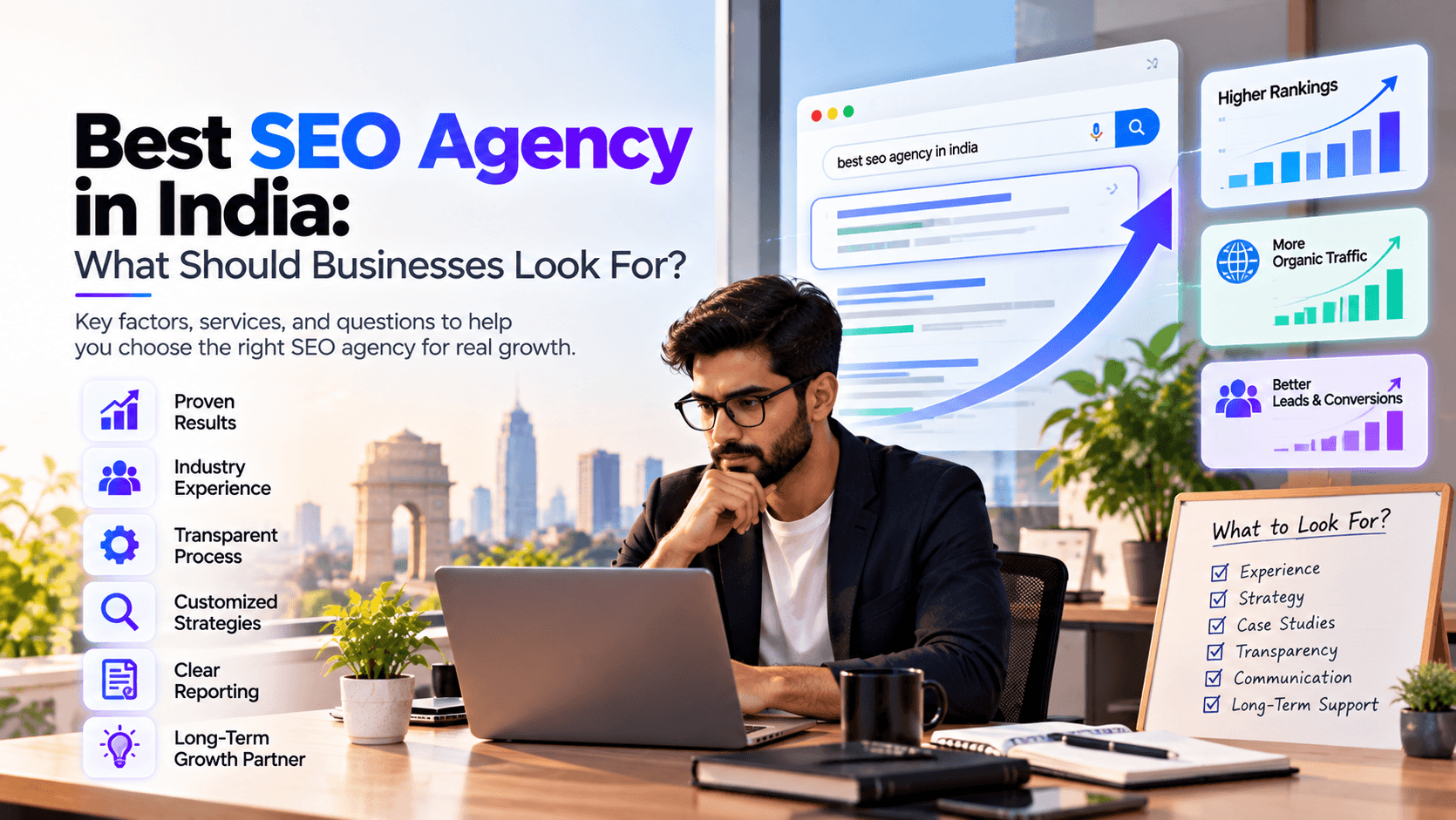
Choosing the best SEO agency in India starts with understanding what your business actually needs from search. From technical SEO and content strategy to authority building, AI search visibility, and measurable conversions, businesses need an agency that combines strategy with transparent execution. This guide covers the key factors to evaluate before selecting an SEO partner.
Choosing an SEO agency isn't about finding a company that can nudge a few keyword rankings anymore. In competitive markets, SEO shapes how customers discover your brand, judge your expertise, compare solutions, and eventually become leads or customers. That makes picking an SEO partner a strategic business decision, not just another marketing purchase, and getting it wrong can cost you far more than the retainer, it can cost you a year of momentum while a competitor compounds theirs.
The trouble is that nearly every SEO agency in India promises the same thing: higher rankings, more traffic, better visibility, more leads. Those promises tell you nothing about how the agency actually works. Real SEO takes far more than publishing blogs and building backlinks, it means understanding the business, researching customer intent, fixing the website's technical foundation, creating genuinely useful content, building authority, measuring commercial outcomes, and adapting as search evolves. And search is evolving fast, with more people using AI-powered experiences, so it's worth checking whether an agency understands both traditional SEO and these newer environments. So what should you actually look for when evaluating the best SEO agency in India? Let's break it down.
What an SEO agency actually does
An SEO agency helps you improve visibility in organic search and attract relevant users. Depending on your objectives, that can span technical SEO, keyword research, search-intent analysis, content strategy, on-page optimisation, internal linking, site architecture, local SEO, digital PR and authority building, link acquisition, competitor analysis, conversion optimisation, analytics and reporting, and increasingly AI-search visibility.
But SEO services shouldn't be treated as a checklist. Publishing 30 articles a month doesn't automatically create organic growth, the agency has to understand which topics matter to your audience, which pages can generate commercial value, how those pages connect, and what competitive advantage you can actually offer. The quality of the strategy matters far more than the number of tasks completed. A useful way to test this in a sales call is to ask the agency to describe a client where they chose to do less, fewer pages, a narrower focus, a pause on link building, because it was the right call. Agencies that only ever add activity, never subtract it, are usually selling volume rather than thinking.
Start with your business goals, not SEO packages
Before comparing agencies, define what you want SEO to achieve, because different businesses need completely different things. A SaaS company may want qualified demo requests, an ecommerce brand wants product discovery and revenue, a local business wants calls and enquiries, a B2B company wants high-value leads from specific industries, and an enterprise brand wants visibility across multiple categories and markets. So the first question isn't "how many keywords will you rank?" It's "how will SEO contribute to our business goals?" A good agency connects SEO activity to real business metrics, search visibility to qualified traffic to engagement to lead to sales opportunities to revenue, giving SEO a commercial purpose instead of making rankings the finish line.
This matters because the wrong goal quietly distorts everything downstream. An agency measured on traffic will chase easy, high-volume, low-intent terms, because that's what makes the graph go up, even if none of it converts. An agency measured on a qualified pipeline will make very different choices about which pages to build and which searches to ignore. Naming the goal upfront isn't a formality; it decides the entire shape of the work.
Look for strategic and technical depth
SEO has a lot of moving parts, and different sites have different problems, a site with thousands of indexed pages faces a very different challenge from a 20-page startup. A strong strategy weighs your current traffic and rankings, technical health, indexation, site structure, search intent, competitor visibility, content quality, backlink profile, brand authority, conversion rates, target markets, and commercial pages, and the agency should be able to explain why it's recommending each activity. If the strategy sounds like the same checklist every client gets, keep asking questions. A genuinely strategic agency will usually tell you what not to do first, which underperforming pages to prune, which keywords aren't worth the fight, which markets to leave for later, because focus is where most SEO budgets are won or wasted.
Technical SEO is the foundation everything else runs on, since even excellent content struggles if search engines can't efficiently discover, crawl, understand, or index key pages. A capable agency understands crawling and indexation, robots.txt, sitemaps, canonicals, redirects, status codes, duplicate content, JavaScript SEO, site architecture, Core Web Vitals, mobile usability, internal linking, structured data, pagination, international SEO, and URL structures, and is comfortable working with developers when changes are needed. That last point is easy to overlook and often decisive: an agency can write flawless recommendations, but if it can't communicate clearly with your engineering team, translate fixes into tickets, and prioritise them against everything else the developers are juggling, those recommendations sit untouched for months. If an important product page is accidentally blocked from crawling, publishing more blogs won't fix it. Technical SEO isn't just an audit exercise; it's about finding the problems that actually hold back visibility and helping you implement the fixes.
Keyword research, content, and topical authority
Keyword research is more than chasing high search volume, it's about what people are trying to accomplish. For a CRM company, "what is CRM?" is informational, "CRM software for small business" is evaluation, and "CRM software pricing" is close to a decision. A good agency builds topic strategies around search intent, buyer journey, commercial value, relevance, competition, existing authority, and conversion potential, so you don't spend months chasing traffic that never becomes valuable. The sharpest agencies also weigh winnability honestly; they'll tell you when a term is realistically out of reach for your domain right now, and where the achievable wins actually sit, rather than promising the whole map.
On content, ask how they decide what to publish. If the answer is just "more blogs," push for a deeper explanation, a strong strategy identifies customer questions, commercial topics, informational gaps, competitor weaknesses, product-related searches, and internal-linking opportunities, and the content itself offers something useful: original research, expert opinion, first-hand experience, data, comparisons, or practical frameworks. The point is never to create hundreds of pages just because keywords exist, exactly the argument behind category-led SaaS SEO over blog volume. And ranking one page rarely makes you an authority, so in competitive industries SEO usually means building a network of related content around important subjects and connecting it through internal links, which a good agency can map into a clear content architecture. When an agency can show you how a single commercial page is supported by a cluster of informational pages feeding it authority and internal links, you're looking at someone who thinks in systems rather than one-off posts.
Authority, AI search, and measurement
On authority and links, the question isn't "how many backlinks will you build?" It's "what authority-building strategy will you use?" Look for digital PR, industry publications, expert contributions, research-based content, partnerships, and genuine editorial mentions, and be cautious of anyone leaning on large volumes of low-quality links. A sustainable approach prioritises relevance, credibility, and real value, which is increasingly how brand mentions build authority in AI answers too. Cheap link packages don't just underperform, they can create genuine risk, and cleaning up a toxic backlink profile later often costs more time and money than doing it properly the first time.
On AI search, the environment is expanding beyond the traditional results page, so it's fair to ask a modern agency how its SEO strategy accounts for AI search. The answer shouldn't be a pile of buzzwords, it should connect AI-search visibility to fundamentals like crawlability, content quality, clear information architecture, topical coverage, entity clarity, original information, brand authority, search intent, and structured information. Importantly, AI search isn't an excuse to abandon traditional SEO, Google's own documentation says the foundational practices used for Search remain relevant to its generative AI experiences, so the best agencies understand how traditional SEO and AI search fit together, the whole premise of running SEO, GEO, and AEO as one connected strategy. Watch for the two failure modes here: agencies that dismiss AI search entirely because it's inconvenient, and agencies that oversell it as a magic new channel that replaces everything. The truth sits in the middle, and a credible partner will say so plainly.
On measurement, a monthly report of keyword positions isn't enough. Ask what they'll track, organic impressions and clicks, non-branded traffic, commercial keyword visibility, organic conversions, qualified leads, demo requests, revenue, conversion rate, landing-page performance, and technical health, with the exact metrics tied to your business model. An ecommerce brand cares about organic revenue; a B2B SaaS company cares about qualified pipeline and demo conversions. The point is to establish a real link between SEO activity and business outcomes, not just movement in a rankings chart. Non-branded traffic deserves particular attention, because branded search often rises for reasons that have nothing to do with SEO, so an agency that quietly counts branded traffic as its own win is flattering the numbers rather than proving impact.
People, pricing, promises, and case studies
Good reporting answers three questions: what happened, why, and what's next, ideally with a performance summary, key wins, traffic and ranking changes, conversion trends, content published, technical improvements, authority work, issues found, and next month's priorities. Avoid reports that are all numbers and no interpretation. A dashboard is not a decision, and you're paying for decisions.
Case studies reveal more than homepage claims, but don't get dazzled by percentages, ask about the starting point, business model, industry, markets, timeframe, the actual work done, what changed, whether leads or revenue moved, and whether results held. A three-hundred-percent traffic jump from a near-zero baseline is almost meaningless; a steady, sustained lift in qualified enquiries for a mature site is the real signal. A relevant case study beats a dramatic one from an unrelated industry, so a B2B SaaS company should specifically want to see how the agency handles long sales cycles, product-led searches, and content built for multiple stages of the buying journey. Understand who will actually work on your account too, since the person selling the engagement often isn't the one executing it, so clarify who owns strategy, technical SEO, content, keyword research, authority building, analysis, and reporting, and how often senior strategists are involved. A small senior team that stays close to the work often beats a large agency where nobody senior touches your account after the pitch.
Don't choose on price alone. SEO pricing varies with website size, competition, geography, industry, page count, technical complexity, and content and link requirements, and a very cheap package usually means limited strategic work, while a high price doesn't guarantee quality. Compare scope, expertise, execution quality, strategic depth, reporting, and expected business value, and ask exactly what the fee includes. Be wary of unrealistic promises like "guaranteed number-one ranking," "10,000 backlinks a month," "results in seven days," or "secret Google technique"; a professional agency explains opportunities and risks instead. Zero Theory covers why guaranteed rankings are a red flag in its own content, so this piece focuses on the broader selection framework rather than repeating it.
Finally, ask how they use AI in their workflow, and where human expertise stays involved. AI can speed up research, briefs, competitor analysis, data analysis, optimisation, and reporting, but using AI doesn't automatically make a strategy better. The best workflows combine AI-assisted research with human strategy, expert content, and editorial review, and Google itself cautions against using generative AI to mass-produce pages without adding value, the same standard behind producing AI content without the slop. If an agency's efficiency comes entirely from generating more content faster, with no human judgment layer, you're likely to end up with a bigger website and a weaker brand.
What the best SEO agency in India actually looks like
There's no universal agency that's perfect for everyone, the right partner depends on your business model, industry, growth stage, target market, budget, competition, website maturity, internal team, and revenue goals. But the strong ones share a consistent set of traits: strategic thinking that understands your business before recommending tactics, technical expertise to find and fix problems, content expertise built on customer needs, commercial understanding that connects SEO to pipeline and revenue, credible authority building, AI-search awareness without abandoning fundamentals, transparent reporting that explains rather than just presents, clear communication, and the adaptability to change course when the data says something isn't working. And remember to look beyond rankings: moving a low-value keyword from position 40 to 8 matters far less than improving visibility for high-intent searches that generate qualified enquiries. Judge an agency on its ability to connect search visibility to meaningful business outcomes, not on keyword count alone.
Before you sign, run a quick self-check: does the agency understand your industry and customer, has it analysed your current website, can it explain its strategy clearly, does it grasp technical SEO and search intent, does it have a thoughtful content and authority plan, does it understand AI-search developments, will it measure conversions and commercial outcomes, who actually works on your account, and how does it handle underperforming campaigns? Clear, specific, evidence-backed answers give you a much stronger basis for the partnership. And pay attention to how the agency handles the questions it can't answer neatly, because an honest "we'd need to audit that before promising anything" is worth far more than a confident answer that turns out to be a script. SEO is a long-term investment, so evaluate the agency not just on what it promises at the start, but on the quality of its thinking, execution, communication, and ability to adapt over time. The right partner won't just tell you where you'll rank; they'll tell you where you are now, where the real gaps are, what needs to change, how they'll execute it, and how you'll both know whether it's working.