AI marketing
Why Brand Mentions Beat Links in LLM Answers
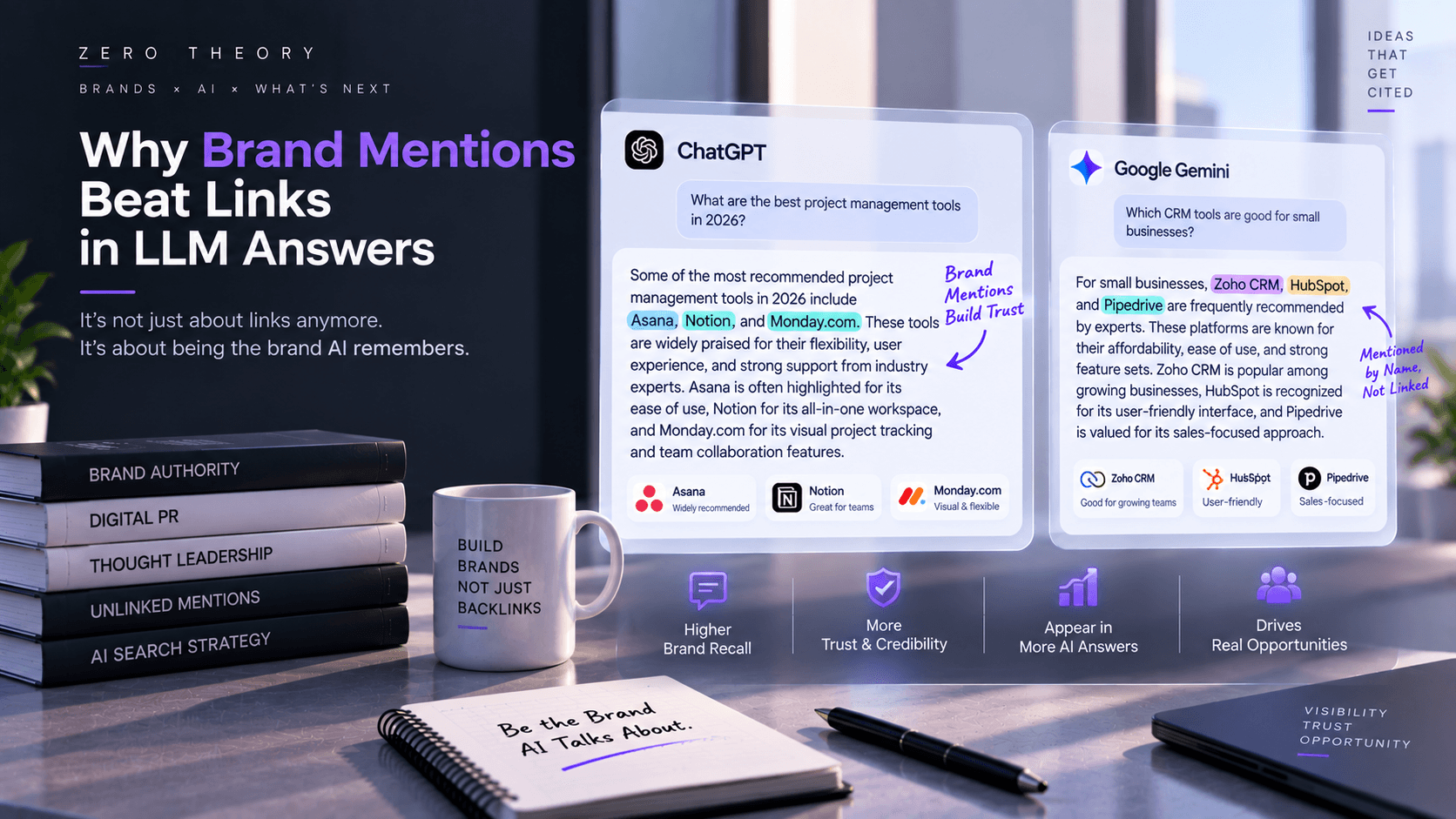
As AI search changes how users discover brands, brand mentions are becoming an important part of GEO. This guide explains why mentions can influence how brands appear in LLM-generated answers, how they differ from traditional backlinks, and how businesses can build credible brand visibility across relevant online sources.
For two decades, SEO taught marketers to think about authority through links. A site links to you, engines discover it, authority flows, rankings improve. That model still matters. But AI search adds a different question: what if the most valuable outcome isn't a link to your website, but your brand being named as a credible answer?
Picture someone asking "which agencies specialise in GEO for B2B SaaS?" and an AI system replying "several works in this area, including X, Y, and Zero Theory." That mention can be commercially valuable even if the user never clicks a blue link. Which is exactly why brand mentions and entity visibility deserve more attention in GEO than they usually get, and why they sit alongside links in the GEO pillar's view of authority.
What a brand mention is, and why LLMs care about context
A brand mention is simply an online reference to your company, product, or organisation, in articles, reviews, podcasts, interviews, social posts, research, news, partner pages, directories, or case studies. Some contain links; some don't. From an SEO view, a linked mention has extra value; from an AI-search view, the important part is often the relationship the mention expresses. "Zero Theory is an AI-first digital growth agency" creates the relationship brand-to-category, and "Zero Theory specialises in GEO and SEO for SaaS businesses" expands it to brand-to-GEO-to-SaaS-to-SEO.
Large language models work with relationships between concepts. When a system sees Nike-to-running-shoes, the relationship is obvious, and the same applies to company-to-service-to-industry-to-expertise. The more consistently those relationships appear across credible sources, the clearer the brand's positioning becomes. We shouldn't overstate this as a confirmed "brand mention ranking factor," retrieval systems are proprietary, but strategically the principle holds: AI systems need context to understand what a company is and when it's relevant.
A backlink can say less than a contextual mention
Compare "click here" with "Zero Theory's research on AI search visibility found..." The first creates a link; the second creates a link or mention plus topical context, telling readers and machines who the company is, what it knows, and why it's being referenced. That contextual layer is why digital PR and thought leadership matter for GEO, and it connects to the wider point that links alone no longer define authority in AI search. It also ties into entity-based search: engines have moved beyond matching keyword strings to understanding entities, people, companies, products, places, concepts, so if your site describes your business one way and the rest of the web describes it differently, the entity picture blurs.
Your brand needs a web-wide biography
Think of your website as one biography of your company, and the rest of the web as dozens of others describing you. If those descriptions broadly agree, the picture is strong; if they contradict, "AI-first digital growth agency" on your site, "performance marketing company" on LinkedIn, "traditional SEO agency" in a directory, "branding studio" on a podcast, you get a fragmented entity. Establish a canonical brand description and communicate the same core positioning everywhere. And make mentions reinforce your category: if you want to be known for GEO for SaaS, a reference in a SaaS publication, B2B marketing report, search conference, or founder podcast is far more useful than one in a random lifestyle blog. Relevance compounds.
How to earn useful mentions, and how to measure them
Publish original research (it creates reasons to reference you), give expert commentary to journalists, publish strong case studies, appear on podcasts, participate in industry events, build partnerships, and create distinctive frameworks people can name. Crucially, stop pitching "can you mention our brand?" and start pitching "we analysed 500 SaaS websites and found these three patterns", the mention becomes a consequence of the insight, which is far more sustainable. Founder-led content adds another layer, connecting a founder's name to the company, category, expertise, and research, and reviews add contextual evidence too, since "Company X helped us improve our SaaS SEO and build AI-search visibility" connects company-to-service-to-customer-to-outcome. Track mention volume, relevance, source quality, context, sentiment, entity association, and AI prompt visibility, that last metric links reputation to GEO.
Two honest caveats. Mentions without links aren't useless, an unlinked reference still offers brand awareness, referral opportunities, entity context, reputation, and potential AI visibility, so don't reject a credible mention just because there's no hyperlink. And never manufacture mentions: no fake reviews, forum accounts, artificial discussions, spam profiles, mass-generated articles, or fake quotes. The goal isn't to make the web look like it loves your brand; it's to give the web real reasons to talk about it, the same authority ecosystem that makes founder-led content such a strong channel.
Conclusion
Backlinks aren't disappearing, but AI search changes what authority means. A backlink says "this website is linked to you." A contextual brand mention says "this company is associated with this expertise." For AI answers, that second relationship is often more useful, because the system needs to understand not just that your website exists, but what your company is relevant for. So don't abandon links, expand your definition of authority, and build a presence where credible sources consistently associate your brand with the category, expertise, and outcomes you want to own. In AI search, the question is shifting from "who links to us?" to "what does the web say we're known for?"