SEO and GEO
GEO vs SEO: What Changes, What Carries Over in AI Search?
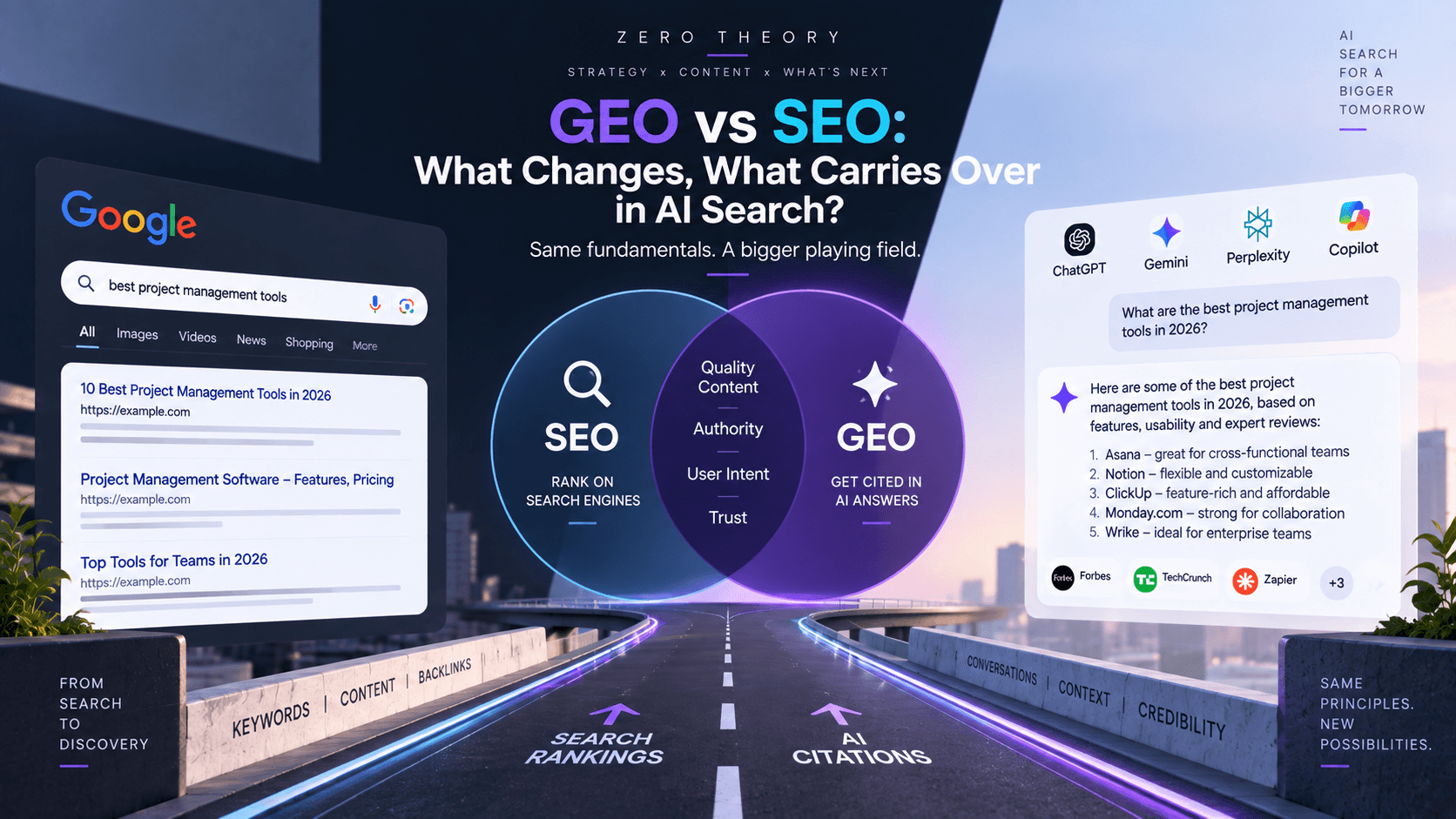
GEO and SEO share many foundational principles, but AI search is changing how brands need to optimize their content. This guide explains GEO vs SEO, what remains important from traditional SEO, what changes for AI search, and how businesses can adapt their content strategy for visibility across both search engines and generative AI platforms.
SEO isn't dead. It's just no longer the whole story of search visibility.
As Google rolls out AI Overviews and AI Mode, and platforms like ChatGPT and Perplexity increasingly answer questions directly, businesses have a new problem to solve: how do we make our brand understandable and useful to AI-powered search? That's where Generative Engine Optimization, or GEO, comes in.
The trouble is that GEO usually gets pitched as a replacement for SEO. It isn't. Google's own documentation is unusually blunt here: the same foundational SEO best practices still apply to AI features in Search, and there are no additional technical requirements or special optimisations needed specifically for AI Overviews or AI Mode. So the better question was never "SEO or GEO?" It's "which parts of SEO still matter, and what extra work does AI search add?" That distinction is the foundation of a sensible 2026 strategy, and it builds directly on the GEO fundamentals covered in our pillar guide.
GEO vs SEO in simple terms
The cleanest way to hold it: SEO helps your website become discoverable and competitive in search results, while GEO helps your brand and content become understandable, retrievable, and potentially mentioned or cited in AI-generated answers. There's a lot of overlap, technical accessibility, useful content, authority, and clear architecture matter to both, but the desired outcome differs. Traditional SEO drives ranking, then click, then website visit, then conversion. GEO adds another path: question, then AI retrieval, then a mention or citation, then brand consideration. The search journey is expanding, not disappearing.
What has actually changed?
The biggest change is the interface. Someone used to search "best SaaS SEO agency," get a list, open a few pages, compare, and decide. Now that same person might ask "which SEO agencies specialise in SaaS and have experience with AI search?", and an AI system may synthesise several sources into a shortlist with links. The question for your business becomes "why would the system include us?" That's a genuinely different optimization problem, and it's the exact shift that makes funnels leak when channels aren't connected.
What carries over from SEO
More than most GEO discussions admit.
Technical accessibility still matters: Google explicitly says pages must be indexed and eligible for Search to appear as supporting links in AI Overviews or AI Mode, so crawlability, indexation, robots.txt, canonicals, internal linking, rendering, performance, mobile usability, and HTTPS all remain important. GEO doesn't bypass technical SEO.
Content quality still matters: Google's generative AI guidance emphasises unique, non-commodity content with original viewpoints and first-hand experience, and AI search only makes generic content less defensible, publishing the 501st version of the same explainer gives the system no reason to pick you.
Search intent still matters: people still have questions, problems, and comparisons; the format changes but the underlying need doesn't, whether someone asks "how much does B2B SEO cost?" or "best fintech marketing agencies in India?"
Internal linking still matters: Google recommends making important content easy to find through internal links, and AI search leans on the broader architecture of the web, so a GEO strategy page should connect naturally to GEO services, AEO, AI Overviews, ChatGPT search, entity SEO, technical SEO, and case studies.
What changes with GEO
The biggest shift is that ranking is no longer the only visibility outcome. You now have to think about citations, mentions, recommendations, entity recognition, prompt visibility, source selection, and brand context. GEO is also more than optimising a page, it increasingly involves your company's whole digital identity. If your website says "SEO and digital marketing," LinkedIn says "AI-first growth agency," a directory says "advertising company," and a podcast calls you a "performance marketing consultancy," which description should an AI system believe? That's why entity consistency matters, and why brand mentions carry weight in AI answers even when they aren't traditional backlink targets. Original evidence becomes the competitive edge too: one company publishing a "SaaS SEO benchmark of 500 B2B websites" gives the web something to reference that a hundred "SEO is important" pages never will.
Where AEO fits, and what shouldn't change
AEO, Answer Engine Optimization, sits between SEO and GEO, focused on making content answer questions directly. They overlap heavily, which is why they should run as one connected system, the case made in full in AEO explained. And plenty shouldn't change: some marketers are abandoning keyword research, technical SEO, internal links, and rankings, which is a mistake, since Google states its generative AI features are rooted in core Search ranking and quality systems. SEO isn't the old thing GEO replaces; it's the infrastructure GEO builds on. What should change is your reporting, adding AI citations, mentions, recommendation rate, prompt coverage, competitor visibility, and AI-referred traffic, especially now that Google has introduced Search Console reporting for visibility from generative AI features.
A practical SEO + GEO strategy
Don't build two departments, build one system. Fix technical SEO so the site is crawlable and indexable, build a strong commercial architecture of service, product, category, industry, and comparison pages, create answer-focused content around real customer questions, add original value through research and case studies, strengthen entities so your brand and expertise are consistent, earn legitimate authority across the wider web, and monitor AI visibility on the prompts your customers actually use. The biggest GEO mistake is chasing a technical trick to make AI cite you; there's no durable shortcut, because systems, retrieval, and models all change. The durable move is to make your business easy to understand and genuinely worth referencing.