AI marketing
SaaS SEO in 2026: Why Category Pages Beat Blog Volume for Long Cycles
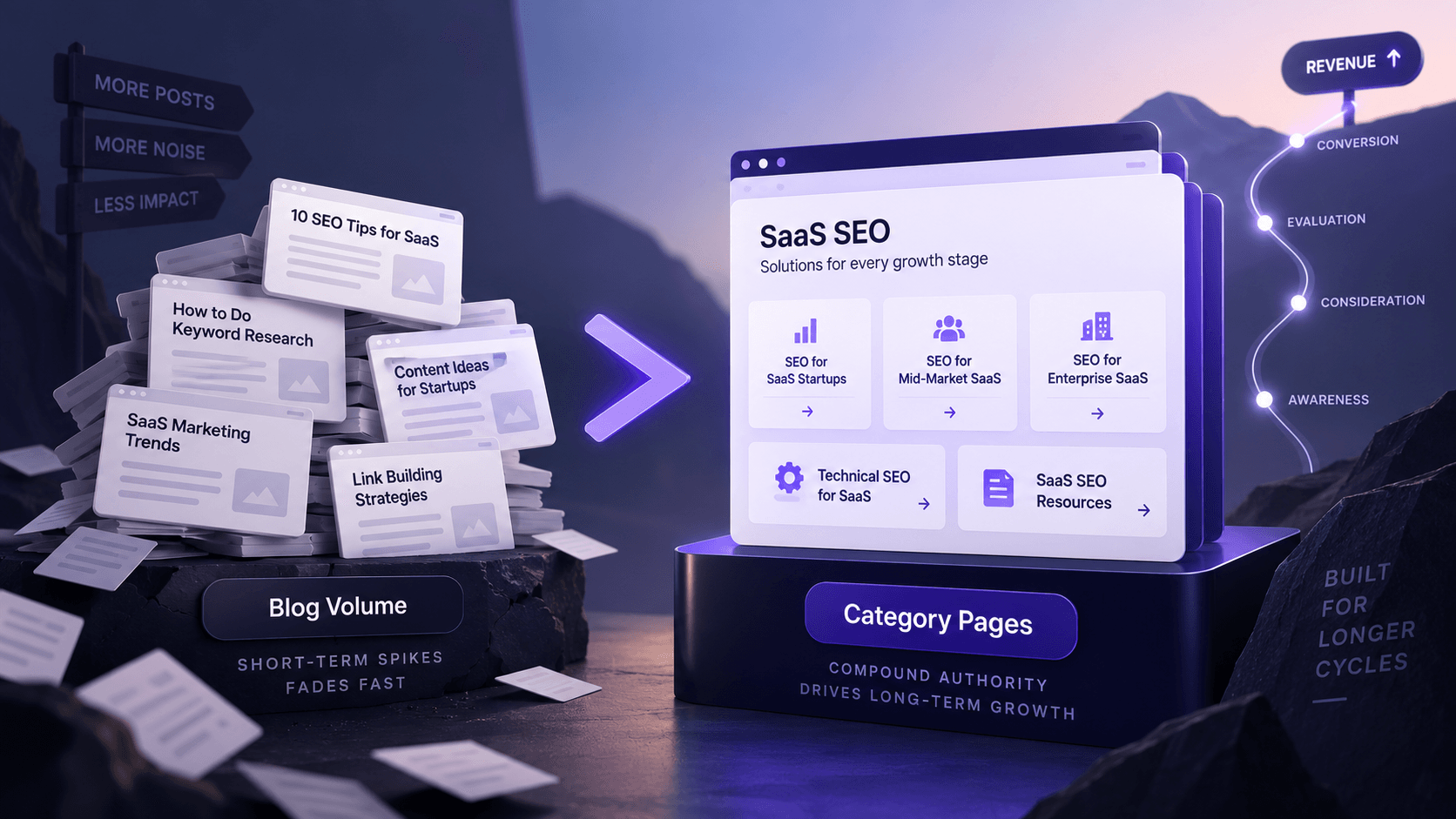
SaaS SEO in 2026 is shifting from publishing more blogs to building stronger category pages. While blog content supports topical authority, well-structured category pages can target high-intent searches, capture long-tail demand, strengthen internal linking, and remain valuable throughout longer SaaS buying cycles. This guide explains why category-led SEO is becoming more effective than chasing blog volume.
If your SaaS SEO plan still runs on "publish 15, 20, or 30 blogs a month," there's a good chance you're pouring effort into the wrong bucket.
The SaaS companies pulling ahead in organic search over long sales cycles aren't the ones with the biggest content calendars. They're the ones that have quietly built a searchable structure around the categories, problems, use cases, integrations, and buying decisions their customers actually care about. That gap between "we publish a lot" and "we own our category" is only getting wider in 2026.
Search itself has changed. Nobody's decision now lives inside ten blue links. A buyer bounces between Google, comparison pages, review sites, a Reddit thread, your docs, a LinkedIn post, a YouTube walkthrough, and an AI-generated answer before they ever decide who makes their shortlist. This is exactly why Zero Theory treats SaaS and B2B growth as a long-cycle problem, one that runs on category positioning, demand generation, founder-led content, and revenue visibility, rather than SEO as a standalone activity you can read more about in our take on an AI-first digital marketing agency.
So the better question isn't "how many blogs should we publish?" It's "which pages should exist for every meaningful buying moment?"
How blog volume became the default SaaS SEO play
The old playbook was easy to follow, and that's exactly why everyone ran it. You'd find keywords, build a calendar, publish, chase backlinks, climb the rankings, and repeat. When competition was thinner and search journeys were more or less a straight line, it genuinely worked.
But SaaS search doesn't behave that neatly anymore. Picture a VP of Sales hunting for revenue intelligence software. Over a few weeks they might search "how to improve sales forecasting," then "revenue intelligence software," then "revenue intelligence vs CRM," then "best revenue intelligence platform," then "revenue intelligence software for B2B SaaS," and finally "Company A vs Company B."
Those aren't six unrelated keywords. They're six ways of circling the same commercial category. A blog-first approach tends to treat each one as its own content ticket. A smarter approach treats them as connected stops on a single buying journey.
Category pages sit closer to buying intent
A blog post answers a question. A category page helps someone understand a market. That's a bigger difference than it sounds.
Take two pages side by side. One is a blog titled "10 Ways to Improve Customer Support Efficiency." The other is a category page titled "Customer Support Automation Software." The first pulls in someone still researching the problem. The second pulls in someone actively shopping for a solution. Neither is "better," they just do different jobs.
For a SaaS company with a long sales cycle, that second page deserves far more of your attention, because it lives right next to the money. A strong category page can explain what the category actually is, who needs it, which problems it solves, which capabilities matter, how vendors differ, what implementation looks like, which integrations are non-negotiable, what results to expect, and where your product fits in all of it. That's useful to a human reader and to a search engine trying to figure out what you sell.
The real problem isn't blogs, it's missing architecture
Let's be clear: blogs aren't the villain here. The villain is content with no structure holding it together.
A SaaS site can publish 500 articles and still leave a visitor unsure of what the company actually sells. You end up ranking for sales enablement tips, sales productivity, CRM automation, sales reporting, lead management, pipeline management, and forecasting, but none of it connects back to a clear commercial hub. From the outside, the site reads like a magazine, not a category leader.
That's dangerous in SaaS specifically, because almost nobody buys off the back of one article. They move through a sequence: problem, then category, then use case, then comparison, then product, then proof, then demo. Your SEO structure should quietly guide people along that path. If it doesn't, your best content is doing volunteer work with no manager. It's the same reason funnels leak when your channels aren't wired into one system.
Build the category before you scale the blog
Good SaaS SEO starts by naming the commercial categories you want to own. Say you sell an AI sales platform. Your structure might look like this:
- Core category: AI Sales Software
- Supporting categories: Sales Automation Software, AI Sales Assistant, Revenue Intelligence Software, Sales Forecasting Software, Lead Qualification Software
- Use cases: lead qualification, pipeline forecasting, sales coaching, deal intelligence, account prioritization
- Industry pages: sales software for SaaS, for fintech, for agencies, for enterprise sales teams
- Integration pages: Salesforce, HubSpot, Slack, Microsoft Teams
- Comparison pages: AI sales software vs traditional CRM, sales engagement vs sales intelligence, Product A vs Product B
Now your blog has somewhere to send its authority. Instead of publishing an article and crossing your fingers that it converts, every article feeds a larger commercial system that's built to close.
Category pages make internal linking actually work
Google reads the relationships between your pages to understand how your site is organized. It openly recommends clear navigation from category pages down to subcategories and products for ecommerce, and the same logic applies cleanly to SaaS: your important pages should be reachable through meaningful links, not buried in a content archive nobody clicks past page two of.
Here's how it plays out. You publish "How to Reduce Sales Admin Work." That article links up to your Sales Automation Software category page. That category page then links out to your use cases, integration pages, customer stories, comparisons, and demo page. The blog stops being the finish line and becomes one door into a much bigger room.
Don't let your category page turn into a thin landing page
Quick warning, because this trips people up. When marketers hear "category page," they sometimes ship a 600-word landing page stuffed with keywords and three product screenshots, then wonder why it doesn't rank or convert. That's not a category page. That's a placeholder.
A category page that earns its spot is genuinely helpful. A structure that works well usually covers the category definition and who it's for, the real problem buyers are feeling, the capabilities a serious solution needs, use cases across different teams, how vendors and approaches differ, the integrations that matter, proof in the form of results and case studies, a practical framework for evaluating options, a few high-intent FAQs, and an obvious next step.
The goal was never "hit 2,000 words." The goal is to take the uncertainty out of a buying decision, so the reader feels ready to talk to sales instead of ready to open ten more tabs.
SaaS SEO in 2026 has to account for AI search
Here's another reason structure beats volume: AI answer engines run on entities, relationships, categories, products, use cases, and evidence. Vague copy gives them nothing to hold onto.
A site that says "we build the best software" is basically invisible to an AI trying to summarise your market. A site that clearly signals which category it belongs to, which customers it serves, which problems it solves, which tools it integrates with, how it stacks up against alternatives, and what evidence backs the claims is far easier to quote in an AI answer. That's exactly why Zero Theory extends past classic SEO into GEO and AEO, so your brand shows up in AI-generated answers, not just the traditional results page. Structured category ownership is quickly becoming one of the highest-leverage things you can build.
So what should your SaaS blog actually cover?
The answer isn't "stop blogging." Blogs still pull real weight. Their job just needs to change from "produce volume" to "support the buying journey."
- For awareness: cover things like why sales teams struggle with forecasting, what revenue intelligence really is, and the signs your sales process has gone too manual.
- For consideration: go with revenue intelligence vs sales analytics, how to evaluate sales automation software, and which integrations actually matter.
- For decision: publish best-of roundups, pricing explainers, head-to-head comparisons, and implementation checklists. And
- For customer success: help buyers onboard their team, measure adoption, and improve day-to-day usage.
The rule of thumb is simple: every article should have a commercial reason to exist. If you can't name the buying moment it serves, it probably doesn't need to be written yet.
The 70/30 rule for SaaS content
Here's an easy way to split your effort. Put roughly 70% of your strategic energy into strengthening commercial architecture: category pages, product pages, use-case pages, industry pages, integration pages, comparison pages, and case studies. Let the other 30% go to editorial content that supports that structure, like educational blogs, thought leadership, research, trend pieces, founder perspectives, and tactical guides.
The exact ratio will shift by company. The principle won't: build your money pages before you build the content machine that feeds them.
Measure pipeline, not publishing speed
One of the most common SaaS SEO mistakes is treating output like results. "We published 25 articles" is an activity number. "We generated 42 qualified opportunities from organic search" is a business number. Only one of those survives a board meeting.
Your SEO dashboard should follow the money: organic qualified leads, organic opportunities, pipeline influenced by organic, demo conversion rate, category-page assisted conversions, revenue from organic, non-brand growth, rankings for commercial terms, AI visibility, and assisted conversions. Traffic still counts, but traffic with no commercial pull is just a fancier vanity metric. If you want the reporting side to hold up, it starts with attribution your executives will actually trust.
A practical SaaS SEO architecture for 2026
If you're rebuilding a SaaS site right now, layer it like this. Start with a category to own the market you want to be known for. Add a product to explain exactly what you do. Add use cases to show how customers apply it, then industry pages to tailor the pitch to different ICPs, then integrations to catch ecosystem-specific searches, then comparisons to help buyers weigh alternatives, then evidence through case studies and original data, and finally editorial to answer the wider questions around your category. Stacked together, that's a connected system, not a pile of loose articles.
Conclusion
The future of SaaS SEO isn't fewer blogs because blogs stopped working. It's fewer disconnected blogs.
The strongest SaaS SEO strategy in 2026 opens with a harder question: what category do we want the market, Google, and AI search engines to link to our brand? Once you can answer that, you build around it. Create the category page. Build the use cases. Map out industry and integration paths. Publish the comparisons. Add the proof. Then let editorial content strengthen the whole system.
That's a tougher road than "three blogs a week." It's also much closer to how SaaS buyers actually buy. The goal was never to own more URLs. It's to own more of the decision.