SEO and GEO
Brand Identity Beyond the Logo: What Businesses Need to Build a Strong Brand
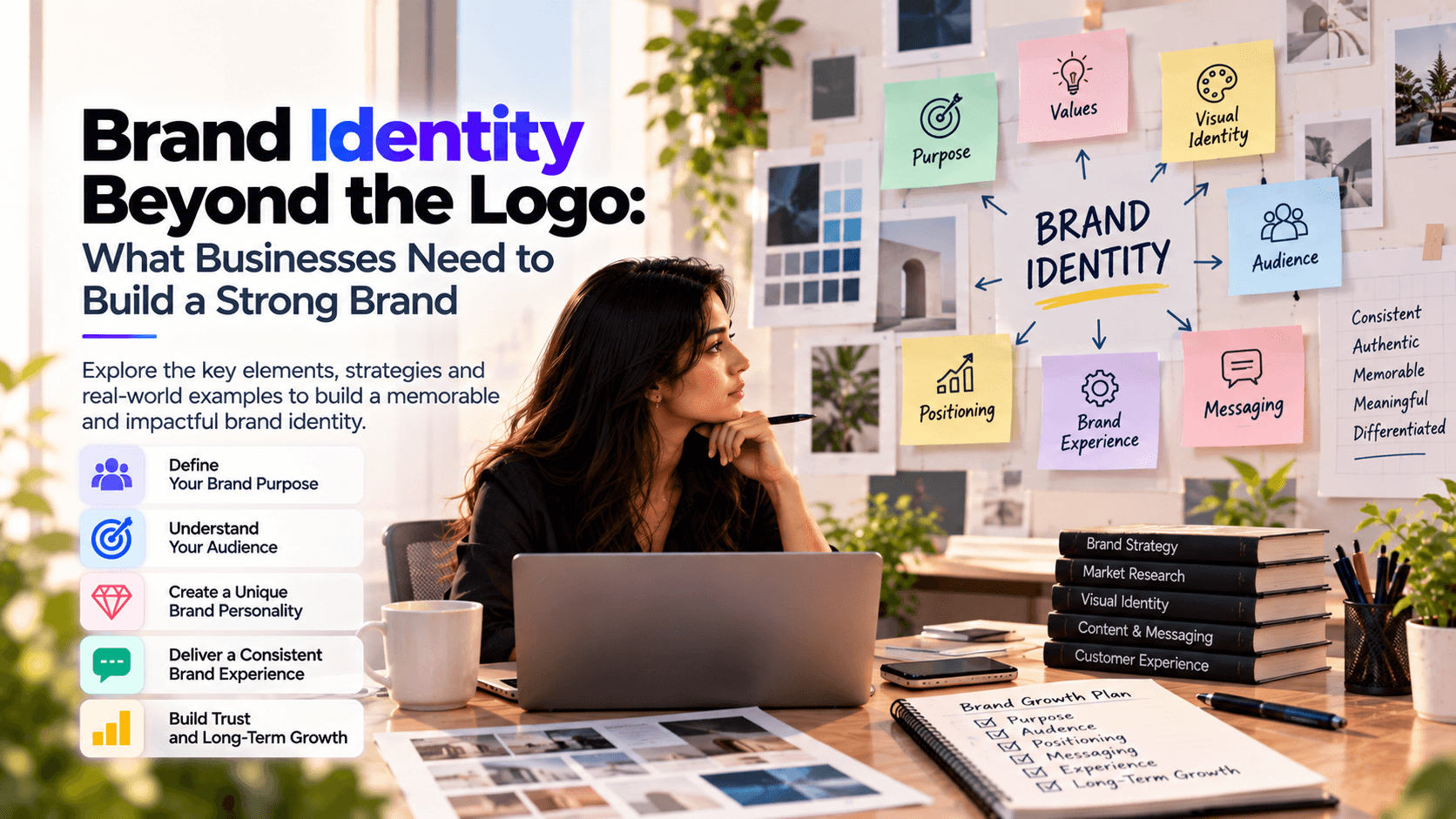
A logo is only one part of a strong brand identity. Businesses need a complete system that connects strategy, positioning, messaging, visual identity, digital experiences, and customer interactions. From colors and typography to tone of voice and brand guidelines, every element should work together to make the brand recognizable, consistent, and memorable.
A logo is usually the first thing people picture when they think about branding. It's also one of the smallest parts of a complete brand identity.
A logo can make a business recognisable, but recognition alone doesn't build a strong brand. Customers also need to understand what the business stands for, who it serves, why it's different, what it promises, and what they can expect every time they interact with it. That's why brand identity has to go well beyond logo design. A strong identity pulls together strategy, positioning, messaging, visual design, customer experience, and consistent communication into a system that lets a business present itself the same way across websites, social media, advertising, sales decks, content, and customer interactions. For a startup, that clarity builds credibility. For a growing company, it creates consistency across teams and channels. For an established business, it can modernise perception while keeping recognition. And in crowded markets, a strong identity makes it easier for customers to understand why the brand deserves attention. So what does a business actually need to build a strong brand beyond a logo? Let's walk through it.
What is brand identity?
Brand identity is the set of strategic, verbal, and visual elements a business intentionally creates to communicate who it is. It can include brand positioning, purpose, values, target audience, personality, messaging, tone of voice, the logo system, typography, colour palette, photography direction, illustration style, graphic elements, website design, social media identity, presentation templates, marketing collateral, and brand guidelines.
Think of the logo as the signature of a brand, and the identity as everything that makes that signature recognisable, meaningful, and consistent. Two companies can have completely different logos and equally strong identities; what matters is whether their visual and verbal systems communicate a clear, memorable idea.
Why a logo alone isn't enough
Picture a company with an attractive logo, but a website in different colours, social posts in different fonts, sales decks in another visual style, ads in a completely different tone, and employees who each describe the company differently. The logo may be beautifully designed, yet the overall experience feels inconsistent. That's the common trap: the company has a logo, but it doesn't have a brand system.
Customers meet businesses through many touchpoints, Google, AI search, social media, an ad, a referral, a website, a sales deck, an email, a product, a proposal, customer support, and every interaction shapes perception. A strong identity makes all of those feel like they belong to the same company, which is the same "connect it, don't silo it" logic behind treating marketing as one system rather than isolated channels.
Strategy, positioning, and messaging come first
One of the biggest mistakes is starting with the logo. Before deciding what the brand should look like, you have to understand what it should mean. Brand strategy tackles the real questions: who are we serving, what problem do we solve, what market are we in, what makes us different, why should customers believe us, what do we want to be known for, and what personality and perception should the brand carry? Those answers drive the creative direction, a fintech brand targeting enterprise finance teams needs a very different identity from a consumer lifestyle brand, and while both may want to feel trustworthy, they express that trust in completely different ways. Strategy is the reasoning behind the identity.
Positioning then answers a simple question: what should customers associate with your brand? No company can own every idea, so it has to choose. A software company might position itself around simplicity, enterprise reliability, speed, automation, security, affordability, or innovation, connecting its capabilities to something meaningful for the audience, often framed as audience plus problem plus solution plus differentiation plus proof. Messaging is part of identity too, because words carry the brand as much as visuals do. It defines taglines, value propositions, headlines, product descriptions, brand statements, sales messaging, website copy, and calls to action. "AI-powered solutions for modern businesses" says little; "automate the repetitive work your finance team should never have to do manually" names a specific problem and audience, and good messaging helps customers grasp the value fast.
Tone of voice gives the brand personality, and consistency is what holds it together. A brand might be professional, conversational, bold, technical, friendly, direct, educational, premium, or playful, and while tone can flex by context, a confident homepage, a detailed whitepaper, an empathetic support message, everything should still feel like the same brand.
The visual system: logo, colour, type, and imagery
Moving beyond the logo doesn't mean the logo stops mattering. It remains an important asset, but professional brand identity design treats it as part of a larger system, a primary logo plus secondary versions, a symbol or mark, horizontal and stacked layouts, light and dark variants, small-size versions, and separate digital and print usage, so it works everywhere from websites and mobile screens to business cards, presentations, ads, product interfaces, and documents. The goal isn't just something attractive; it's something functional and recognisable.
Colour is a strategic asset, not a matter of personal taste, so a good project weighs industry conventions, audience expectations, competitive differentiation, accessibility, digital and print applications, contrast, and cultural considerations, usually building a primary colour for recognition, secondary colours for campaigns, and neutrals for backgrounds and information, which stops every designer picking a different shade. Typography gives the brand a distinct voice too, often underestimated, since the font on a website shapes how a brand feels; a tech company may want a clean modern typeface, a luxury brand something more refined, so the identity should define primary and secondary typefaces, heading and body styles, weights, sizes, and spacing for consistency and readability. And photography and visual direction matter, because stock images make a brand look generic when every competitor uses the same look, so guidelines should decide whether imagery feels authentic, premium, energetic, minimal, technical, human, editorial, or documentary, extending to illustrations, icons, animation, video, and motion, the collective visual language of the brand.
Guidelines, digital identity, and cross-channel consistency
Brand guidelines turn identity into a maintainable system, so nobody has to guess how assets should be used. A good guideline document covers the brand foundation (purpose, mission, vision, values, positioning, personality), verbal identity (messaging, tone, writing principles, key phrases, examples), visual identity (logo rules, colours, typography, imagery, icons, graphics), and applications (website, social, presentations, documents, advertising, sales materials), becoming a reference for internal teams, freelancers, agencies, and partners.
Digital brand identity is far more than making a website look good, since so much of the brand experience now happens online. A website should communicate who the company is, what it offers, who it serves, why it's different, why to trust it, and what action to take, with the visual identity translating naturally into UI components, buttons, forms, navigation, layout, typography, animation, imagery, and micro-interactions, so the site feels like an expression of the brand, not a disconnected template. And the identity has to work across the whole ecosystem, website, paid ads, social, email, sales deck, proposal, product, customer experience, because if a customer sees one look in an ad, a different one on the site, another tone in an email, and a third style in a proposal, the brand gets harder to remember. A strong identity provides reusable assets and rules that keep cross-channel communication consistent, which is exactly what stops the funnel leaking between channels and vendors.
Brand identity, SEO, and AI search
Brand identity looks separate from SEO, but the two increasingly overlap. Search engines and AI systems need to understand what a company does, who it serves, and what it's associated with, and a clear brand reinforces those relationships through consistent company descriptions, product names, service categories, expertise, author information, customer proof, about-page content, and third-party mentions. This isn't about designing a logo for SEO; it's about building a consistent identity that's understood across your website, content, external platforms, and touchpoints.
That clarity increasingly shapes AI-search visibility too. Instead of "which websites rank for this keyword?", people now ask "which companies are best for solving this problem?", and to be considered, a brand's identity has to be clear. The web should consistently communicate brand to category expertise to audience to products to prove, for example a company understood as a B2B SEO agency, focused on SaaS SEO, serving B2B technology companies, offering SEO and GEO services, backed by documented expertise. When positioning is fragmented across platforms, both humans and systems struggle to understand what the business is known for, which is why brand identity now extends into digital identity and entity clarity, the same foundation behind how brand mentions build authority in AI answers.
Experience, gaps, and choosing a partner
A brand promise means little if the experience contradicts it. If a company positions itself as premium but delivers poor support, confusing onboarding, and inconsistent communication, customers notice the gap. So identity should align with customer experience across the brand promise, website experience, sales experience, product experience, and support experience, each stage either reinforcing or weakening the brand, which is why branding can't be a marketing-only project.
It's also worth separating brand identity (what the company intentionally creates and communicates) from brand image (how customers actually perceive it). The company controls its identity; the audience determines its image. A business might want to be "the simplest enterprise software platform," but if customers keep calling it complicated, there's a gap, and research and feedback help you find it.
Brand identity work pays off at key moments: launching a new business, entering a new market, expanding the product portfolio, repositioning, merging or acquiring, growing the marketing team, scaling internationally, or simply looking outdated. When you evaluate a brand identity agency, don't judge only the logo portfolio, ask to see the thinking behind the work: the strategic process, positioning expertise, research methodology, messaging capability, visual systems, digital experience, guidelines, relevant industry experience, and implementation support.
The right agency explains how it arrived at an identity, framing the work as "here's the business problem, here's the positioning, here's the creative strategy, and here's how the identity expresses it," not "here are three logos, pick one." And a strong project leaves you with more than a logo folder, potentially brand strategy, a positioning statement, messaging, logo and colour and typography systems, a visual language, guidelines, social and presentation templates, sales collateral, website direction, a digital design system, motion guidelines, and an asset library, but above all, a clear understanding of how to use the identity, which is what turns branding into a usable system that pairs naturally with an AI-first approach to the whole growth stack.
Conclusion
A logo can identify your company. A brand identity should explain it, and that difference is significant. A strong identity defines what you stand for, who you serve, how you're different, how you communicate, and how that shows up consistently across every touchpoint. The best identity isn't the one with the most elaborate logo or the trendiest palette, it's the one that makes the business easier to recognise, understand, remember, and trust.
That's why modern branding has to go beyond visual design, connecting strategy, positioning, messaging, visual identity, digital experience, and customer experience. When those work together, the brand stops being an image and becomes a system the whole business can use to communicate consistently and grow, and it needs to be recognisable to humans and understandable to machines at the same time.