SEO and GEO
Best Performance Marketing Agency: Services & Results (2026 Guide)
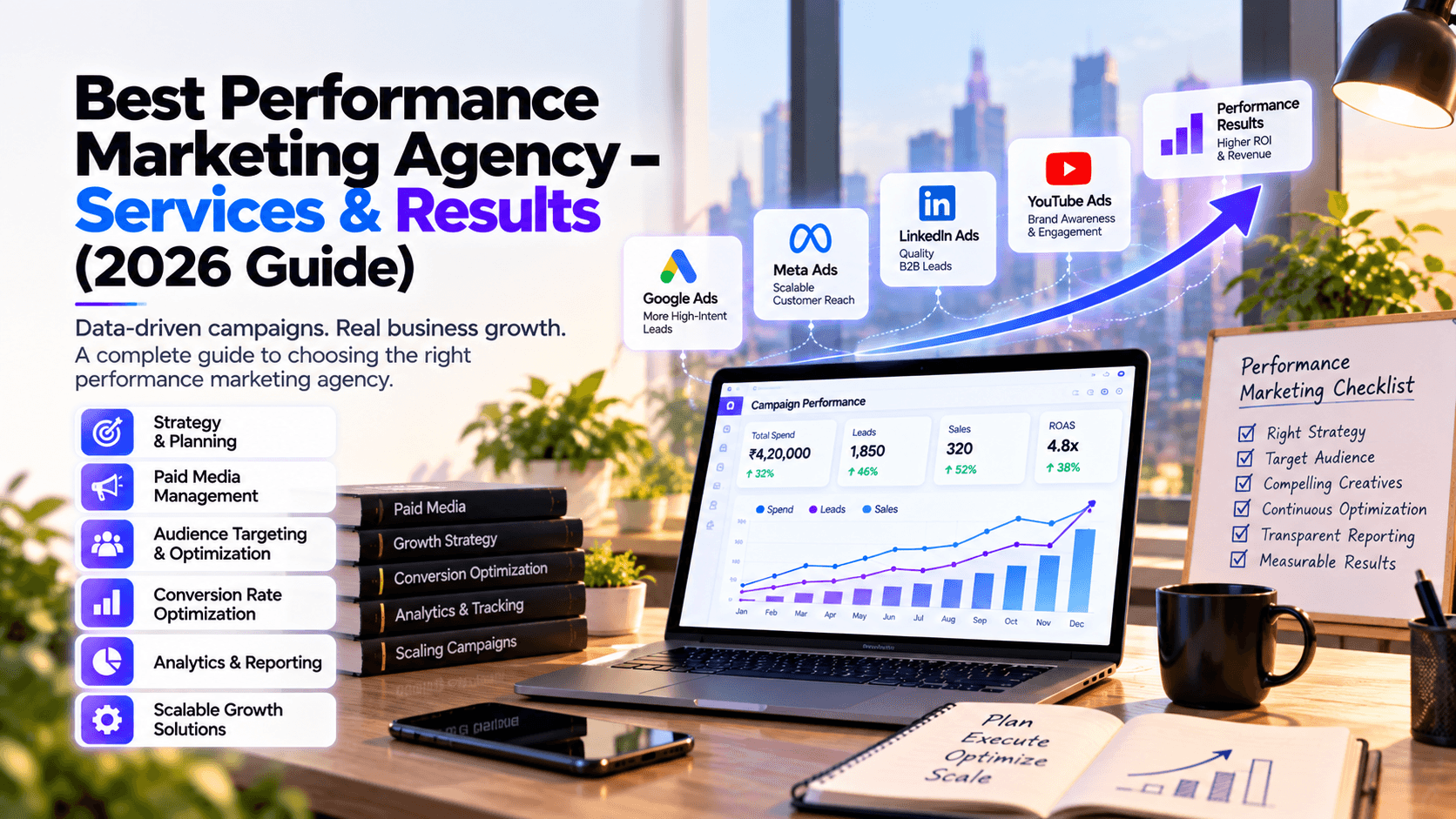
The best performance marketing agency is not necessarily the one that generates the most clicks or cheapest leads. It is the agency that connects advertising activity with meaningful business outcomes.
Performance marketing has changed a lot. Businesses aren't competing for clicks or impressions anymore, they're competing for profitable customer acquisition, qualified leads, purchases, pipeline, and measurable revenue.
That's exactly why choosing a performance marketing agency takes more than comparing service lists or asking what they charge to run Google or Meta. A modern partner has to understand the whole path from advertisement to business outcome, the audience, offer, creative, landing page, conversion tracking, media buying, attribution, sales process, and customer value. In 2026 that matters even more, because ad platforms increasingly use automation and machine learning to handle bidding, targeting, placements, and optimisation. So a good agency's role has moved well beyond manually adjusting campaigns, strategy, experimentation, creative direction, measurement, and commercial judgment now carry the weight. So what should you look for in the best performance marketing agency, and what should a serious one actually provide? Let's break it down.
What is performance marketing?
Performance marketing is a digital approach where campaigns are planned, measured, and optimised around specific business outcomes, purchases, qualified leads, demo requests, app installs, registrations, calls, sales opportunities, subscription starts, or revenue. The defining feature is the emphasis on measurable performance. Traditional advertising often leans on reach and awareness; performance marketing asks a different question: what business outcome did the marketing actually generate?
An ecommerce company measures revenue and return on ad spend. A B2B SaaS company measures qualified demos, sales opportunities, customer acquisition cost, and pipeline. A local business focuses on calls, enquiries, bookings, and store visits. So performance marketing should be built around your business model, not sold as a fixed advertising package.
What a performance marketing agency does
A performance marketing agency runs and improves digital advertising campaigns to generate measurable business results. Depending on the client, that spans Google Ads, Microsoft Ads, Meta, LinkedIn, YouTube, display, remarketing, paid social, shopping campaigns, lead-generation campaigns, landing page optimisation, conversion rate optimisation, creative testing, audience research, conversion tracking, attribution, analytics, CRM integration, reporting, and budget optimisation.
But simply offering those services doesn't make an agency effective. The real difference is how the activities connect. An agency can generate thousands of clicks, yet if that traffic never converts into valuable customers, the campaign isn't a success, which is the whole reason paid media can't run in a silo, exactly the point behind connecting channels into one growth system rather than isolated activities.
Why it matters more in 2026
Paid media platforms have become heavily automated, with Google, Meta, and others using machine learning for bidding, audience selection, placements, optimisation, and creative delivery. That changes what you should expect from an agency. The value is no longer "someone who can operate an ad platform." It's strategy plus data plus creative plus experimentation plus measurement plus commercial judgment. Zero Theory's own research on paid media makes the same distinction, platform automation handles much of the execution, while humans stay essential for strategy, positioning, creative direction, budget allocation, and business decisions, which is unpacked in how AI changed paid media buying and what still needs a human.
Start with business goals
Before choosing an agency, define what success means. For ecommerce it might run from ad spend to purchases to revenue to profit. For B2B SaaS, from ad to landing page to demo to qualified opportunity to customer. For real estate, from ad to enquiry to qualified lead to site visit to booking. For consumer services, from ad to phone call to appointment to customer. That's why an agency should ask about your business before recommending a campaign. If it proposes a monthly budget without understanding your economics, sales cycle, average order value, customer lifetime value, and conversion process, the strategy is incomplete.
Paid media, tracking, and creative
Paid media usually sits at the centre, and a capable agency picks platforms based on where your customers actually spend time and show intent. Google Ads captures existing demand through search, shopping, Performance Max, display, YouTube, and app campaigns, with search especially useful when people are actively looking. Meta suits demand generation, lead generation, ecommerce, retargeting, creative testing, and audience discovery, drawing strength from combining creative, audience signals, and platform optimization. LinkedIn works for B2B when you need targeting by job title, industry, company, seniority, or company size. The right channel follows the business, not popularity.
Conversion tracking is the foundation. Without reliable tracking, optimisation gets very hard, so a professional setup may use Google Tag Manager, Google Analytics, Google Ads conversion tracking, the Meta Pixel, conversion APIs where appropriate, CRM integration, offline conversion imports, enhanced conversions, UTM tracking, and server-side measurement. For B2B especially, measurement should go beyond form submissions, since a form fill isn't necessarily a valuable lead. The business needs to know which campaign generated the lead, whether it qualified, whether sales contacted it, whether the opportunity progressed, and whether it became revenue. That's where performance marketing connects to real business performance.
Creative is one of the most important components. A good agency doesn't build one ad and let it run for months, it tests multiple hooks, headlines, visual concepts, short-form videos, product demonstrations, customer problems, testimonials, offers, and calls to action. The aim isn't volume for its own sake, it's finding which messages resonate with the right audience. A software company might test the same product on four different angles, save time, reduce costs, replace manual workflows, improve team productivity, and let the data decide which deserves more investment.
Landing pages, audience, and structure
Getting the click is only half the journey; the next question is what happens after it. A performance agency should evaluate the landing page for message match, page speed, headline and offer clarity, trust signals, form length, CTA placement, social proof, product information, mobile experience, and friction points. If an ad promises "Get a Free SaaS SEO Audit" but the page opens with unrelated services, the visitor leaves. The ad and page should feel like one journey.
Performance also improves when the agency understands who it's reaching, so audience research spans demographics, firmographics, pain points, purchase motivations, objections, buying triggers, existing customer data, search behaviour, and competitor positioning. For B2B, it may need to account for multiple stakeholders, since the user of a product is often not the person approving the purchase, which affects both targeting and messaging. Campaign structure should serve the strategy, making it easier to test hypotheses, control budgets, understand performance, compare audiences, manage creative, and optimise, and be wary of agencies that treat complicated account structures as proof of expertise, since more campaigns don't automatically mean better performance.
Optimisation, attribution, and lead quality
Launching a campaign isn't the end. Performance marketing runs on a loop of launch, measure, learn, test, optimise, scale, with the agency watching cost per acquisition, cost per qualified lead, conversion rate, click-through rate, cost per click, revenue, return on ad spend, customer acquisition cost, lead quality, and creative and landing-page performance, then acting on what the data shows. Attribution is one of the hardest parts, because customers rarely follow a straight path, they might see a LinkedIn ad, search later, read an article, return, click a retargeting ad, book a demo, and convert weeks on. There's no single perfect model, so an agency should explain its attribution methodology rather than present one number as absolute truth, and for B2B, connecting ad data with CRM information gives a far clearer view of downstream outcomes, the discipline behind building attribution executives actually trust.
Lead quality matters more than lead volume. Picture Campaign A with 1,000 leads at ₹100 each and Campaign B with 200 leads at ₹500 each; A looks cheaper, but if A produces 10 customers and B produces 30, the cheaper lead wasn't the better outcome. So agencies should understand quality, tracking marketing-qualified leads, sales-qualified leads, opportunities, pipeline value, customer acquisition cost, and revenue, because the cheapest lead is rarely the most valuable. Budget allocation should follow the evidence too, shifting with campaign performance, marginal returns, audience size, seasonality, sales capacity, product demand, creative performance, and funnel constraints, and the agency should be able to explain why one campaign gets more spend than another.
Experimentation, reporting, and realistic results
Optimisation improves an existing system; experimentation asks whether the system could work differently, testing new audiences, markets, offers, landing pages, creative concepts, pricing messages, funnel structures, and campaign objectives. A strong relationship balances both, because without experimentation, campaigns eventually get optimised around the same stale assumptions. Reporting should explain business impact, not just show ad-manager screenshots, answering what happened, why, what you learned, what's changing, and what's next, with the exact metrics tied to your model, the same clarity behind treating marketing as one connected system rather than disconnected dashboards.
On results, there's no universal benchmark, a "good" CPA, ROAS, conversion rate, or CAC depends on industry, product, price, audience, geography, sales cycle, competition, funnel, customer lifetime value, platform, and creative quality. So be cautious when an agency promises a specific ROAS or cost per lead before understanding your business. Instead, set a baseline (where are we today?), a target (what improvement are we after?), a measurement approach, a testing plan, and a review period. That's a far more realistic framework.
How to choose, and the red flags
When comparing agencies, weigh strategy (can they explain why they recommend specific channels and campaigns?), paid media expertise, measurement (can they implement reliable tracking and attribution?), creative process, funnel understanding (do they consider what happens after the click?), commercial thinking (do they understand leads, customers, revenue, CAC, and customer value?), reporting in business language, active experimentation, and communication (can you speak to the people actually running your campaigns?). Those matter far more than how many years the agency has existed.
Be cautious when an agency focuses only on impressions and clicks, can't explain its conversion tracking, promises guaranteed results without understanding the business, optimises only for cheap leads, uses the same strategy for every client, can't justify its campaign structure, reports numbers without insight, ignores landing pages, never discusses creative testing, can't connect ad data to CRM outcomes, or treats ad platforms as the entire marketing strategy. A strong agency is comfortable discussing failures as well as wins. And remember the bigger picture: performance marketing doesn't operate alone, a customer may touch paid ads, organic search, AI search, content, social, email, the website, sales, and CRM, so if every channel runs independently, valuable information gets lost. Zero Theory is built around connecting SEO, GEO, performance marketing, automation, brand, and web into one system, and for businesses with multiple acquisition channels, that connected view makes it far easier to see the journey and find where the funnel leaks.
Finally, a future-ready agency understands that advertising is increasingly automated, so the future isn't people manually managing more campaigns, it's combining AI-assisted execution (data analysis, pattern identification, creative variations, research, reporting, campaign insights) with human judgment on positioning, offers, brand, budget, business priorities, creative direction, experiment design, and commercial trade-offs. The strongest model uses both. The best performance marketing agency isn't the one promising the lowest cost per click or the most leads, it's the one that connects advertising activity to meaningful business outcomes through strategy, customer understanding, creative testing, landing-page optimisation, reliable measurement, attribution, experimentation, and continuous optimisation. Get every stage measured and connected, and performance marketing stops being paid advertising and becomes a repeatable customer-acquisition system.