Insights
Healthcare Marketing That Builds Trust: Education-Led Funnels
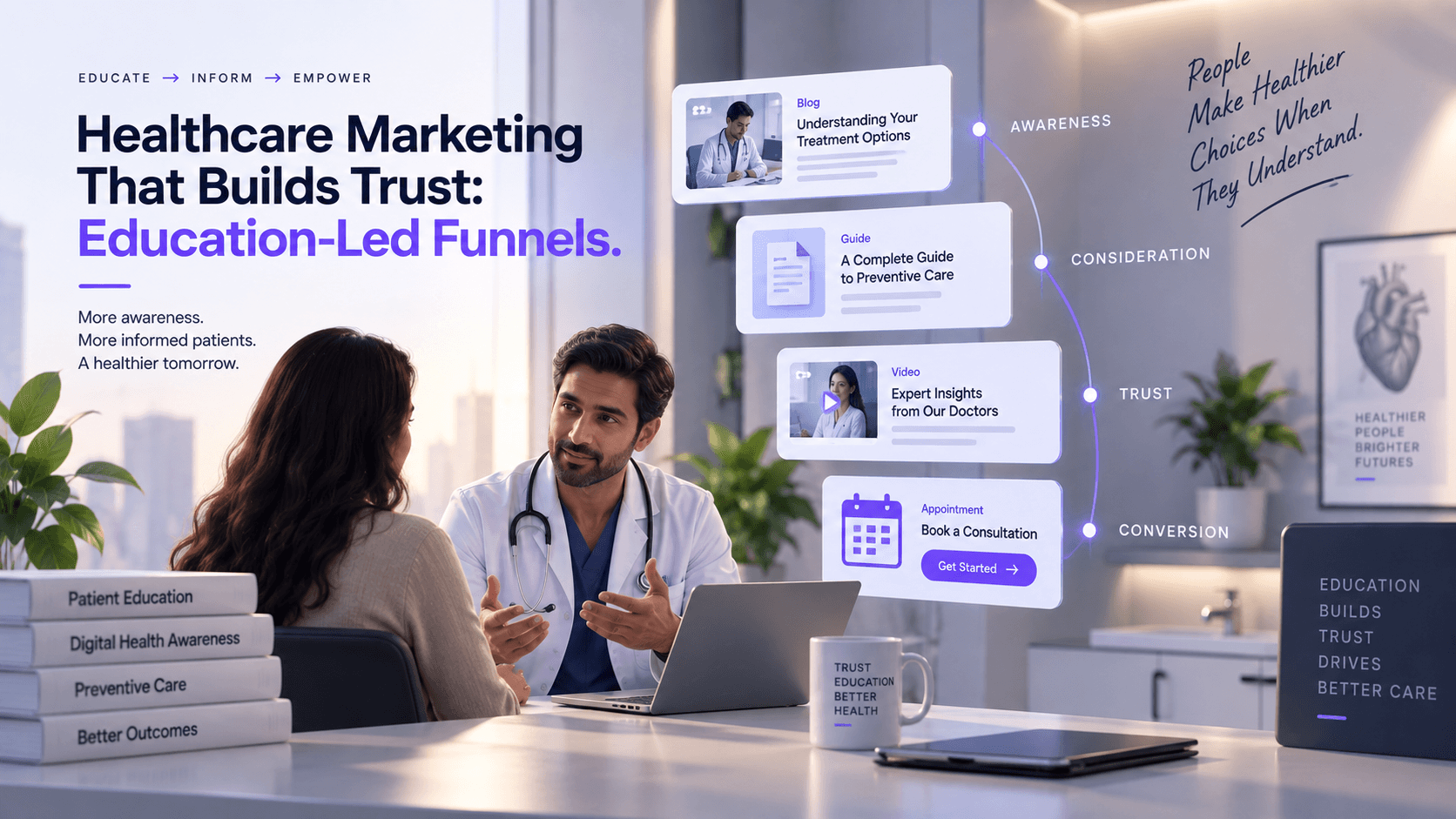
Healthcare marketing is no longer just about promoting services it is about building confidence before a patient makes a decision. Education-led funnels help healthcare brands attract the right audience, answer questions, address concerns, and guide patients toward action. This approach combines valuable educational content with thoughtful conversion journeys to build trust while supporting sustainable patient acquisition.
Healthcare marketing has a conversion problem, and it isn't a lack of demand. The problem is that trust has to come before conversion.
Someone searching for a treatment, a clinic, a diagnostic service, a medical device, or a specialist isn't behaving like someone buying a pair of shoes. They're often uncertain. They may be worried. They may not fully understand their options, they may be quietly comparing providers, they may be asking a family member or their GP, and they usually need several touchpoints before they're ready to act.
That's why the strongest healthcare marketing strategy is rarely "run ads, send traffic, ask for the appointment." A far better model runs on questions, then education, then trust, then consideration, then action, then an ongoing relationship. This matters even more in India, where a single healthcare decision can pull in patients, families, doctors, insurers, and employers all at once. It's the same idea behind Zero Theory's approach to healthcare: trust outranks cleverness, and education, compliance awareness, and a clear point of view do the heavy lifting for complex medical offerings.
Why healthcare funnels need more education
Say someone searches for "best treatment for knee pain." They're almost certainly not ready to book anything yet. First they want to understand why the pain is happening, whether it's serious, what treatments exist, when surgery actually becomes necessary, what recovery involves, roughly what it might cost, and which specialist they even need.
If your marketing jumps straight to "Book an appointment today," you're asking for commitment before you've removed any of the uncertainty. An education-led funnel flips that. It answers the questions first, and only then offers the next logical step, which by that point feels natural instead of pushy.
Education is not just top-of-funnel content
This is a distinction a lot of teams miss. Healthcare education shouldn't be treated as generic awareness fluff that racks up traffic and produces no business. Done right, it supports every stage of the journey.
At the awareness stage it looks like "what causes chronic back pain?" At consideration, "when should you see a spine specialist?" At decision, "what should you ask before choosing spine treatment?" At conversion, "what happens during your first consultation?" And after conversion, "how to prepare for your appointment." Suddenly education isn't a cost centre. It's a connected system that carries people all the way through.
Trust is built through evidence
Polished creativity alone won't carry a healthcare brand. You need proof. That can come from doctor credentials, institutional affiliations, clear treatment information, demonstrable clinical expertise, patient education, facilities, technology, transparent processes, genuine testimonials where appropriate, published research, and relevant recognitions or certifications.
The goal isn't to manufacture the appearance of authority. It's to make real authority easy for an anxious person to see and understand quickly.
The healthcare website should answer anxiety
A healthcare landing page should be built around the questions a patient is actually carrying. Someone weighing up a procedure is thinking: is this right for me, is it painful, how long is recovery, who performs it, what are the risks, what does it cost, will insurance cover it, what happens at the first consultation, and what should I bring?
None of those are objections to conversion. They are the conversion journey. A page that answers them well lowers friction without ever needing aggressive sales copy, which is exactly the system-first thinking that keeps a funnel from leaking between stages.
The education-led healthcare funnel
A useful healthcare funnel breaks into six stages.
- Problem discovery: the user is hunting for information on symptoms, causes, prevention, and treatment options, and your only job is to be useful.
- Condition or service education: they understand the problem and start exploring solutions like tests, specialist types, and recovery, so your job is to build understanding.
- Provider Evaluation: they begin comparing providers on credentials, facilities, expertise, location, and patient experience, and here your job is to build trust.
- Conversion: where they're ready to book, request a consultation, call, or send an inquiry, so your job is to make action effortless.
- Preparation: the patient has converted and now needs to know what to expect, what documents to bring, and how the appointment runs, so your job is to reduce uncertainty.
- Retention: aftercare, follow-ups, reminders, and relevant services keep the relationship going. That's a far stronger structure than treating every single page as a lead-gen form.
Healthcare SEO should start with patient questions
A healthcare SEO strategy shouldn't open with "which keywords have the highest search volume?" It should open with "what does a patient need to understand before they trust us?"
A dermatology practice, for example, might build a core service page for dermatology, then condition pages for acne, eczema, psoriasis, and hair loss, then treatment pages for laser, hair restoration, and chemical peels. Around those, it answers real questions like what causes acne, how long treatment takes, when to see a dermatologist, whether laser is safe, and what to expect afterward. Add proper provider pages for dermatologist profiles, clinic locations, and treatment expertise, and you've built a much richer search footprint than a pile of high-volume keyword posts ever could.
But healthcare content needs stronger editorial standards
This is where healthcare parts ways with most other industries. Pumping out large volumes of generic AI-written medical content isn't a growth strategy, it's a trust risk. It can quietly do real damage.
Healthcare content needs qualified review where appropriate, clear sourcing, accurate terminology, sensible caveats, no unsupported guarantees, no sensational claims, and a clean line between education and diagnosis. The aim is to help readers understand their options without ever pretending an article can stand in for a qualified professional. This is also why AI belongs inside firm guardrails with senior humans accountable, not left to write medical copy unsupervised.
Medical advertising requires care
Healthcare marketing also lives inside professional and advertising standards. The National Medical Commission's published ethics regulations include restrictions around physician advertising, self-promotion, endorsements, and claims about treatments and commercial products.
That points to a clear principle: communicate expertise without turning medical authority into promotional hype. There's a real difference between saying "Dr. X is an expert" and simply providing accurate information about qualifications, registration, specialty, experience, and areas of practice. The second gives the audience something to judge for themselves. The first just asks them to swallow a marketing line. Trust grows faster when evidence does the talking.
Educational content can improve paid acquisition too
SEO isn't the only winner here. Picture a patient clicking a paid ad for "advanced diabetes care." Instead of dropping them onto a bare appointment form, send them to a page that explains what the clinic specialises in, what the first consultation includes, which patients tend to benefit, what diagnostic information might be needed, what to ask, and how to prepare.
Now your paid traffic is entering an education-led path instead of a hard sell. That lifts the quality of the interaction even when the person isn't ready to book that day, which is precisely how performance and education reinforce each other rather than compete.
Retargeting should continue the education
Say someone reads "early warning signs of heart disease." Please don't retarget them with "Book now! 20% consultation offer!" That message is wildly out of step with how the person is probably feeling.
A better next touch would explain what to discuss with a doctor, how a diagnostic evaluation works, when urgent care is warranted, and what a consultation actually involves. The next message should answer the next question, not skip ten steps ahead. That's the difference between a funnel that feels helpful and one that feels intrusive.
Build content around decision anxiety
One of the most effective healthcare content strategies is to map the exact moments patients feel unsure and meet them there. When they're wondering "do I need a specialist?", give them an educational guide. When it's "what happens during the first consultation?", give them a preparation guide. For "what treatment options are available?", build a comparison-style educational page. For "how much does treatment usually involve?", explain the cost factors honestly rather than promising numbers you can't stand behind. And for "what questions should I ask my doctor?", hand them a checklist. This content works because it dissolves the psychological barriers standing between a patient and action.
Patient education can become a brand asset
Healthcare brands tend to compete on the same recycled claims: advanced technology, experienced doctors, modern facilities, comprehensive care, patient-centric service. Every competitor can copy those lines in an afternoon.
Genuinely useful education is much harder to copy. A brand that consistently explains complicated topics in plain language earns a reputation as the provider that helps people understand, and that's powerful. Patients aren't only shopping for treatment. They're shopping for confidence in their decision.
Use doctors and subject-matter experts properly
Healthcare content gets stronger when real expertise is visible, and that doesn't mean sticking a doctor in front of a camera on every page. It means expert knowledge should shape the content itself.
A healthy loop looks like editorial research, then medical review, then content, then patient questions, then updated content. Marketing sees what people are searching for, the medical team sees where patients keep getting confused, the content team turns those insights into genuinely useful education, and the next campaign is sharper than the last.
Measure healthcare marketing beyond leads
Healthcare teams fall into the same trap as everyone else, celebrating traffic, impressions, leads, and appointment requests. The sharper question is always what happened after the lead.
Track qualified enquiries, appointment bookings, actual appointment attendance, treatment enquiries, consultation-to-treatment conversion, revenue per acquisition source, patient retention, and repeat visits where relevant. That gives you a far truer read on marketing quality. A campaign that produces 1,000 low-intent leads can easily be worse than one that produces 200 high-intent consultations.
A practical healthcare marketing framework
Start by identifying the questions patients are trying to answer. Build educational content that answers them accurately. Add credible expertise so qualifications, evidence, and experience are visible. Build service pages that connect that education to the relevant treatments. Create low-friction conversion paths, whether that's an appointment, consultation, enquiry, or call. Keep educating after conversion so patients know exactly what comes next. And measure downstream outcomes so marketing is tied to qualified business results, not vanity numbers.
Trust should outrank clever
Healthcare brands don't need the cleverest headline. They need the clearest one. They don't need the most aggressive funnel. They need the most reassuring one. And they don't need 500 generic articles. They need useful answers to the questions patients actually ask.
That's the whole idea behind education-led healthcare marketing: teach first, prove credibility second, make action easy third. Because a patient is rarely asking "which brand marketed itself best?" They're asking "who can I trust with this?" The marketing system that answers that question, consistently and honestly, will always outperform the one that just shouts louder.