AI marketing
Founder-Led Content: The Highest-Leverage B2B Channel Nobody Resources
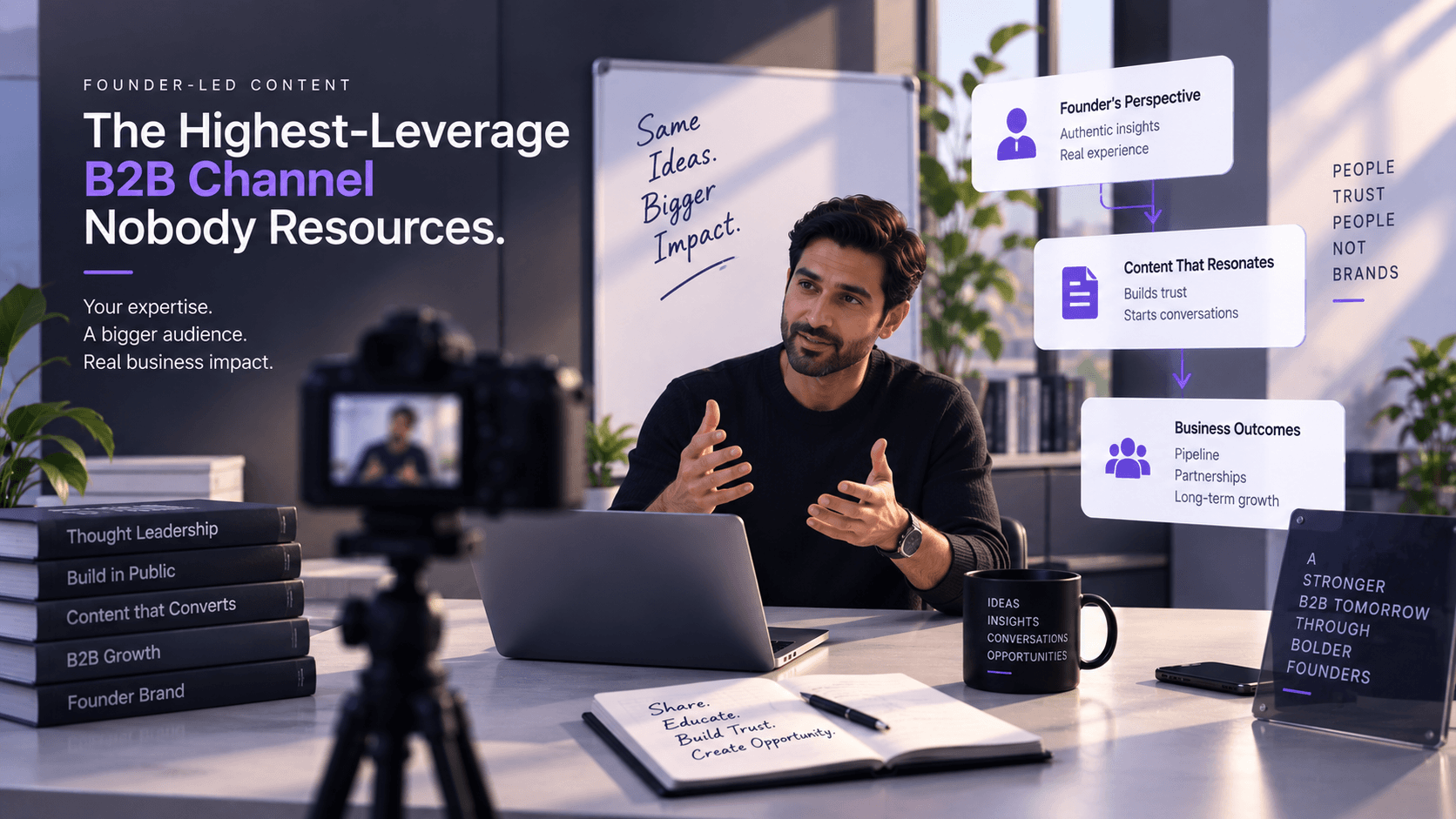
Founder-led content has become one of the highest-leverage B2B marketing channels because buyers increasingly want expertise, perspective, and proof—not just polished brand messaging. When founders consistently share valuable insights, experiences, and opinions, they can build trust, strengthen brand authority, generate qualified conversations, and create demand without relying entirely on paid acquisition.
Most B2B companies don't have a content problem. They have a "someone worth listening to" problem.
The blog ships three posts a week. The LinkedIn page pushes out motivational graphics. Sales forwards product updates. The website has the usual tidy "About Us" story. And somehow, the brand still slides right out of everyone's memory.
This is exactly where founder-led content becomes one of the highest-leverage channels in B2B, and not because founders are naturally gifted writers. It's because buyers usually want to understand the thinking behind a company before they trust the company itself. They want to know what the founder actually believes, what they understand that competitors don't, why they built the thing in the first place, what they've learned the hard way, where they disagree with the crowd, what the market keeps getting wrong, and whether they've truly seen the problem up close. A polished corporate page almost never answers those questions. A founder can.
Founder-led content is not personal branding
This distinction matters more than people think. Personal branding usually gets flattened into "post every day," "share your morning routine," "talk about your leadership journey," "tell everyone what you're grateful for." Fine for some, but it's rarely useful B2B marketing.
Founder-led content is a different animal. It takes the founder's experience, judgment, conviction, and inside access to information and turns the company's real expertise into something visible. A simple formula holds it together: founder insight plus customer problem plus market point of view plus evidence. That combination produces content people can actually use, not just scroll past.
Why founders have an unfair content advantage
Founders sit right next to the information marketers spend months trying to dig up. They hear the customer objections, the sales calls, the product complaints, the pricing pushback, the competitor comparisons, the industry shifts, the hiring headaches, the failed implementations, the investor questions, and the market's biggest misconceptions.
A generic writer has to research all of that. A founder has lived it. That's what makes founder-led content unusually valuable, and it's also why the real challenge is extraction, not creation. Most founders can't sit down and produce 2,000 words every Tuesday, and they shouldn't have to. What they need is a system.
The founder should provide thinking, not production
This is one of the most important principles in the whole approach. Don't hand the founder keyword research, content briefs, drafting, formatting, editing, distribution, repurposing, and analytics. Ask them for the one thing only they can give: judgment.
Try something like "what do SaaS founders consistently get wrong about SEO?" and let them talk for 15 minutes. That single conversation can become a LinkedIn post, a long-form article, a newsletter, a piece of sales enablement, a short video script, a website perspective, and a set of podcast talking points. The founder supplies the raw intellectual material. The system turns it into distribution. That's leverage.
Why the Zero Theory model fits this approach
Zero Theory deliberately places founder branding alongside SEO, paid media, CRM, content, and lifecycle marketing inside its Growth engagement model rather than in a "social" corner. Its wider editorial approach leans on the same split: AI can speed up research and production while senior humans stay accountable for strategy, judgment, and quality. Founder-led content is a natural extension of that thinking, where the founder owns the point of view and the system handles the production and distribution.
The four founder content pillars
A founder-led strategy that actually scales tends to rest on four pillars.
The first is market POV, where the founder stakes out what they believe about the industry, like "why most SaaS companies measure the wrong SEO metric" or "why AI will lower the cost of execution but raise the value of strategy." This is what establishes intellectual positioning. The second is customer insight, the patterns the founder keeps noticing, like "after 50 conversations with SaaS founders, here's the SEO problem I keep seeing." This is what creates relevance.
The third is build-in-public lessons, the things the company has learned, like "what we got wrong about our first positioning" or "why we stopped measuring lead volume." This builds credibility because it's experience, not theory. The fourth is contrarian analysis, the popular advice the founder rejects, like "your B2B brand doesn't need more content" or "ROAS is not your growth strategy." This is what earns attention.
Opinion is the real differentiator
AI has made generic content dirt cheap, and that quietly changed what content is worth. If 500 companies can all generate "10 Tips for Better B2B Marketing," none of that content differentiates anyone.
But when a founder says "we stopped publishing weekly blogs once we realised our commercial pages were weaker than our editorial footprint," that creates curiosity. Now there's an argument on the table. Arguments spark discussion, discussion drives distribution, and distribution builds brand memory. That chain is exactly why founder-led content performs so well on LinkedIn, and why it pairs so naturally with the case for category-first SaaS SEO.
The founder doesn't need to become an influencer
Here's another misconception worth killing. The goal was never "get 100,000 followers." The goal is to become recognisable to the right 5,000 people.
For a B2B company, that circle might include buyers, other founders, CMOs, heads of growth, revenue leaders, investors, partners, industry analysts, and future employees. If the right people keep running into genuinely useful thinking from the founder, the brand gets easier to remember when it counts. That beats broad attention from an audience that will never buy.
Build a founder content operating system
Here's a system that works in practice. Start by creating a founder question bank, with prompts like: what does your industry get wrong, what do customers misunderstand, what changed your mind recently, what would you never do again, what do competitors overpromise, what does your team know that the market doesn't, what's getting harder, what's getting easier, which metric do you distrust, and what would you tell a founder one stage behind you. Those questions generate the raw material.
Next, record conversations rather than staring at a blank document. Twenty to thirty minutes, with real follow-up questions and space for stories. Then extract the strongest ideas, hunting for strong opinions, surprising observations, specific examples, customer patterns, contradictions, lessons, data, and stories. Finally, turn one idea into multiple formats. A single founder conversation can flow into a LinkedIn post, then a long-form article, then a newsletter, then a short video, then a sales insight, then a website section. The point isn't to repeat yourself mechanically. It's to carry one underlying insight into the format each channel rewards.
The founder content flywheel
A strong system runs as a loop: customer conversations feed founder insight, which becomes a LinkedIn post, which drives engagement, which surfaces audience questions, which spark new content, which becomes an SEO article, which brings website traffic, which produces a lead, which turns into a sales conversation, which generates fresh customer insight, which feeds the next founder insight. Each turn of the wheel makes the next one easier. That's far more powerful than treating LinkedIn as a standalone social channel bolted onto everything else.
What should founders actually post about?
The best topics sit right at the intersection of expertise, experience, and market relevance. A SaaS founder might dig into why enterprise sales cycles stall, what buyers really ask during procurement, why product-led growth fails for certain categories, or lessons from pricing experiments. A fintech founder could unpack why financial onboarding is so hard, what customers misread about financial products, the tight link between trust and conversion, and lessons from building inside a regulated environment. A healthcare founder might explore what patients misunderstand, why healthcare UX fails, how trust shapes medical decisions, and what education can resolve before a consultation even happens. The content always gets stronger when the founder is speaking from lived experience.
Avoid the "founder motivational post" trap
One of the quickest ways to make founder content forgettable is to turn every experience into inspiration. "We failed. But we learned persistence is everything. Keep going." Nobody takes anything away from that.
Compare it to this: "We lost a major customer because we assumed adoption would just happen after implementation. It didn't. They finished onboarding, but the team never changed its workflow. Now we measure adoption as a business outcome, not an implementation milestone." That has a real lesson in it. It's specific, it's useful, and it builds credibility precisely because it's uncomfortable and concrete.
Stories beat statements
Put these side by side. The statement version: "customer research is important." The story version: "we thought our biggest onboarding problem was product complexity. Three weeks of customer calls showed the opposite: users understood the product but couldn't get internal approval to change their workflow. So we rebuilt onboarding around stakeholder alignment instead." The second one actually teaches something. That's the bar founder content should be cleared every time.
Use evidence whenever you can
Founder content gets a lot stronger when opinions are tied to evidence, whether that's customer data, campaign results, product usage, sales patterns, experiments, research, industry data, or plain internal observation. You don't need proprietary data in every single post. But the more commercially consequential the claim, the more proof it should carry. That's the same discipline behind attribution and measurement leaders trust: original evidence and human QA over generic AI output.
SEO and founder content reinforce each other
Founder content shouldn't be trapped on LinkedIn. Some of the sharpest ideas make excellent search assets. Say a founder posts "why category pages beat blog volume for SaaS SEO." That's a LinkedIn post, but the discussion underneath it surfaces a cluster of real questions: SaaS SEO strategy, category page SEO, SaaS content architecture, SEO for long sales cycles, commercial intent SEO. Suddenly the founder's point of view has become a connected search strategy. That's how thought leadership and SEO stop competing and start compounding.
Founder content should influence sales
This one is badly underused. Picture a prospect walking into a sales call having already watched the founder talk through the problem, the company's philosophy, hard customer lessons, and where the market is heading. The sales team no longer starts from zero. The buyer already gets how the company thinks, which quietly solves one of the hardest problems in B2B: earning trust from a cold start. Founder content becomes pre-sales education that's doing work long before anyone books a meeting.
Measure founder content differently
Don't grade founder content on likes alone. Track it across four layers. For attention, watch views, reach, and profile visits. For engagement, look at comments, shares, saves, and the quality of the conversations. For commercial signals, follow website visits, branded search, inbound enquiries, demo requests, sales mentions, and pipeline influence. For strategic signals, count customer conversations, partnership openings, speaking invitations, media opportunities, and talent attracted.
The most valuable outcome often won't land on publish day. Someone might follow a founder's content for six months before they ever raise their hand. That's exactly why founder branding is a long-cycle asset, not a quick-win channel.
A weekly founder content system
A realistic cadence looks like this. Monday, a 15-minute founder interview. Tuesday, turn one insight into a LinkedIn post. Wednesday, pull a second insight into a short post. Thursday, develop the strongest idea into a long-form article. Friday, review the comments and questions for the next round of content. That's genuinely enough. The founder doesn't need to spend five hours writing. They need to spend 15 to 30 minutes thinking out loud.
The biggest constraint is consistency
Founder-led content usually dies for one reason: the whole system runs on motivation. The founder posts for three weeks, engagement looks decent, and then a product launch hits, then hiring, then fundraising, and the content quietly vanishes.
The fix is to take content production off the founder's plate entirely and build a machine around them. The founder supplies experience, opinions, stories, and judgment. The content team supplies research, structure, editing, SEO, and distribution. AI can accelerate transcription, research clustering, repurposing, drafting, and formatting. But the founder's judgment stays the source of truth. Everything else is just machinery around it.
The real advantage of founder-led content
The biggest payoff isn't more posts. It's compressed trust. A prospect can spend 30 minutes reading five sharp posts from a founder and walk away understanding the company's worldview better than they would after ten generic website pages. That builds familiarity before the first call ever happens, and in B2B, familiarity is worth a lot.
So the strongest founder-led content never says "look at me." It says "here's what I've learned that might help you make a better decision." That single shift is the whole difference between personal branding and strategic founder content.
Conclusion
Founder-led content isn't a vanity project. Done properly, it's a B2B growth channel that connects expertise to attention to trust to search for conversations to pipeline.
The founder's unfair advantage was never their writing ability. It's their proximity to the truth. They hear the customer, they see the market, they make the calls, they know where the company has failed, they know what competitors misunderstand, and they know which assumptions blew up. That is the content. Marketing's job is simply to extract it, sharpen it, distribute it, and wire it into the wider growth system.
Because on an internet flooded with AI-generated content, generic expertise keeps getting cheaper, while a real point of view keeps getting more valuable. And often the highest-leverage content creator in the whole company isn't sitting in the content team at all. They're sitting in the founder's chair.