SEO and GEO
How to Get Cited by Google Gemini: A Practical Guide to Gemini GEO
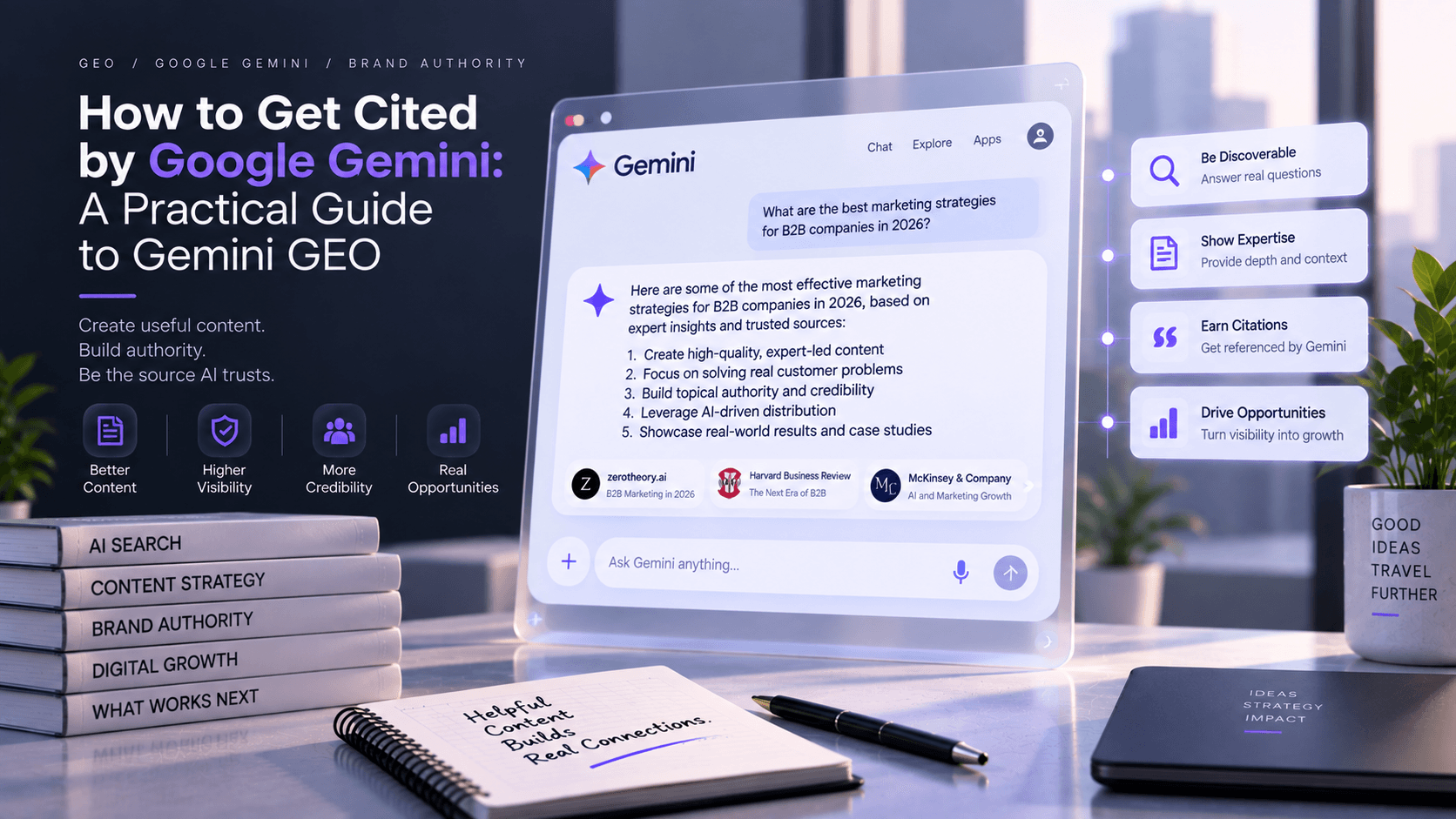
Google Gemini is becoming an important part of how users discover information, businesses, products, and services through AI-powered search experiences. For brands, traditional SEO alone is no longer enough. This guide explains how Gemini GEO works and the practical strategies businesses can use to strengthen their content, authority, and online presence to increase their chances of being cited in Gemini-generated answers.
Google Gemini is becoming another important place people discover answers, and there's a common misunderstanding about optimising for it. You can't just optimize a page for a keyword and expect a citation.
Gemini can use Google Search to ground responses in current web information. Google's documentation explains that when Search grounding is used, Gemini searches, processes results, synthesises an answer, and provides inline citations. Which makes one principle non-negotiable: to be cited, your content has to be discoverable, relevant, trustworthy, and genuinely useful to the question being answered.
How Gemini Search grounding works
Google describes it in stages: user prompt, prompt analysis, Google Search, search-result processing, answer generation, citations. The key point is that with Search grounding, Gemini doesn't rely only on model memory, it retrieves current web information and cites the sources behind the answer. That's a direct GEO opportunity, built on the shared foundation in the GEO pillar.
The Gemini-specific work
Make your site crawlable and indexable, robots.txt, indexing, canonicals, sitemap, internal linking, server access, mobile, and rendering. It sounds basic and it's still one of the most overlooked parts of GEO.
Understand the questions your audience asks, so for enterprise AI consulting you cover what an AI consulting company does, what it costs, how to start AI transformation, the risks, AI governance, implementing AI agents, and best firms by industry, then map content to those needs.
- Answer questions clearly using question, direct answer, explanation, evidence, examples.
- Use trustworthy sources, since Search grounding is designed to improve factual accuracy by grounding responses in web content. If you publish statistics, cite them; if you reference research, link it.
- Create original information, because if 100 sites explain "what is AI transformation?", a "2026 AI Transformation Benchmark: 200 Mid-Market Companies" gives Gemini something distinctive to encounter and others a reason to reference.
- Strengthen your entity, especially important since Gemini sits inside Google's ecosystem, keeping business information consistent across your site, Google Business Profile where relevant, LinkedIn, directories, publications, and partner sites.
- Build topical clusters around a subject like AI transformation (strategy, roadmap, consulting, governance, implementation, agents, ROI, change management)
- Build industry-specific authority, since industry pages like "AI consulting for healthcare" or "for financial services" tend to win qualified prompts, much like the vertical depth in the live fintech marketing compliance guide.
- Create comparison and evaluation content (AI consultant vs internal team, AI agents vs traditional automation, generative vs predictive AI).
- Use structured data appropriately to describe pages and entities without claiming things users can't verify.
- Earn external authority through research, publications, podcasts, and expert commentary.
- Track Gemini prompts with a fixed list recording whether Gemini cited a source, your brand, and your URL, plus competitors and notes. When Gemini cites a competitor, investigate: is their answer more direct, their evidence stronger, their entity clearer, their topical depth greater, their external authority higher? That's your optimisation roadmap.
Avoid the common mistakes
Treating Gemini like Google rankings, writing generic AI content, publishing without sources, ignoring entity SEO, over-optimising keywords, and forgetting freshness. Update pages when the information actually changes, not just the date. And the honest limit again: you can't guarantee a Gemini citation. Google decides when grounding is useful and which sources support the response. The goal isn't certainty, it's raising your probability of being a source Gemini can confidently use.