SEO and GEO
How to Rank in Google AI Overviews in 2026
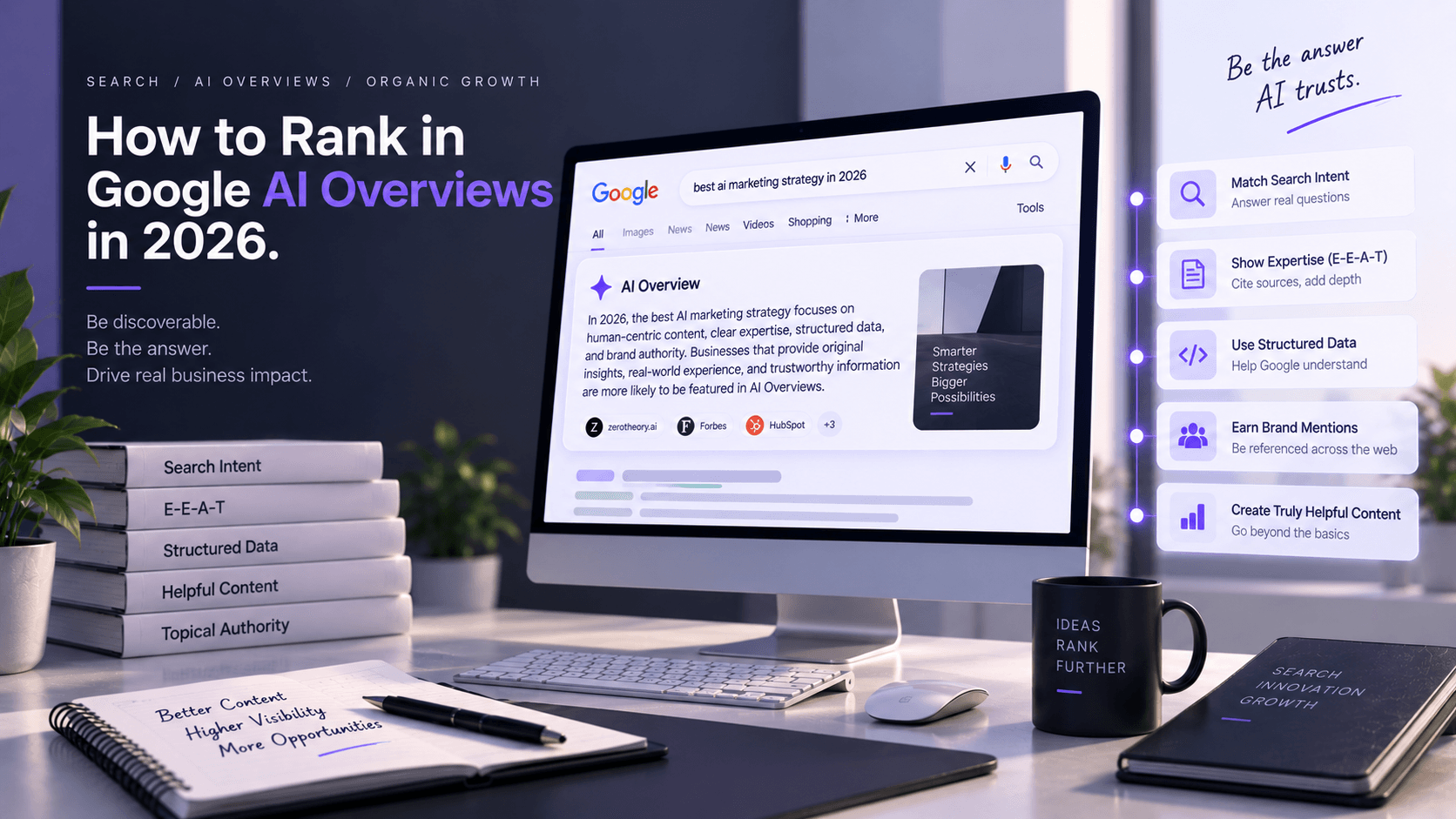
Google AI Overviews are changing how users discover information by providing AI-generated answers directly within search results. Traditional rankings still matter, but brands now need to optimize for visibility within AI-generated responses. This guide explains how Google AI Overviews work, what makes content eligible for inclusion, and the practical SEO and content strategies businesses can use in 2026 to improve their visibility and increase their chances of being cited.
Google AI Overviews have quietly changed what "top of search" even means. Instead of only traditional organic results, users increasingly get an AI-generated summary with links to supporting sources. Google describes AI Overviews as AI-generated snapshots that help people understand a topic and explore further through links. That sets a new objective: don't just rank for the query, become a useful source for the answer.
But there's a catch worth internalising early. There is no "AI Overview ranking button." Google's systems decide when an Overview is helpful and which sources support it. So the real work is raising the probability that your content is seen as useful, relevant, authoritative, and retrievable.
What are Google AI Overviews?
AI Overviews appear when Google's systems judge that a generated answer will help. The result can blend information from several sources and link out so users can dig deeper. For marketers, the journey shifts from "query, organic result, website" to "query, AI answer, source citation, website." Your brand can earn visibility even when the user never touches a classic blue link.
AI Overview visibility is not traditional ranking
One of the biggest GEO mistakes is assuming "if I rank number one, I'll automatically be cited." That's not safe. Traditional ranking and AI citation are becoming related but distinct outcomes, which is exactly the point made in the GEO pillar. Your program should run two goals on shared infrastructure: traditional SEO for rankings and traffic, and GEO to make key content easy for AI to understand and use.
The step-by-step
Find the queries that trigger Overviews. Take your keyword set, classify it (informational, commercial, comparison, problem-solving, local, industry-specific), then for each query record whether an Overview appears, which sources it cites, the answer format, which competitors show up, and which of your pages could answer it. That's your AI Overview opportunity map.
Write around questions, not keywords. For "enterprise AI governance," don't just publish a generic guide; answer what it is, why enterprises need it, what policies matter, who owns it, what a framework includes, and the biggest risks. Now the page holds multiple answer opportunities.
Put the answer near the top. If it takes 900 words to answer a simple question, you've made everyone's job harder. Lead with a crisp definition, then expand. It helps humans and makes the core answer obvious to retrieval.
Create citation-friendly sections that can stand alone, definitions, lists, comparisons, processes, tables, frameworks, and add original evidence so Google isn't staring at a hundred interchangeable pages. First-party data, case studies, calculations, and unique frameworks give your page a reason to exist.
Strengthen topical authority by surrounding a target like "AI marketing" with connected pages (strategy, content, paid media, SEO, GEO, automation, analytics) so your site reads like an entity with genuine expertise. Keep the page technically accessible, indexability, crawlability, internal links, canonicals, performance, mobile, structured data, sitemap, HTTPS, because GEO never eliminates technical SEO. And strengthen entity signals with consistent Organization, Person, Article, Service, and Breadcrumb data so Google knows who created the content and what you specialise in.
Build authority outside your own site through publications, expert commentary, partner sites, original research, interviews, and podcasts, real visibility, not manufactured links. Then monitor citations with a simple sheet tracking query, whether an Overview appears, the cited sources, your citation, the competitor, and the action. When a competitor gets cited, ask what their page provided that yours didn't. That produces better optimisation than adding more keywords.
What formats tend to work?
No format is guaranteed, but source content that earns citations often includes original research, clear definitions, comparison pages, well-sourced statistics, case studies, expert commentary, and detailed guides for queries that need synthesis. The common thread is the same discipline behind good editorial QA for AI content: originality, verification, and clarity.
Common mistakes
Writing solely for keywords, copying competitors, hiding the answer, adding unsupported statistics, over-relying on raw AI-generated content, and ignoring older pages that would be more valuable improved than replaced. And the honest limit: you can't guarantee an Overview. Google decides if and when one appears. You can only improve quality, relevance, accessibility, and authority.