AI marketing
AEO Explained: Answer Engine Optimization in Plain English
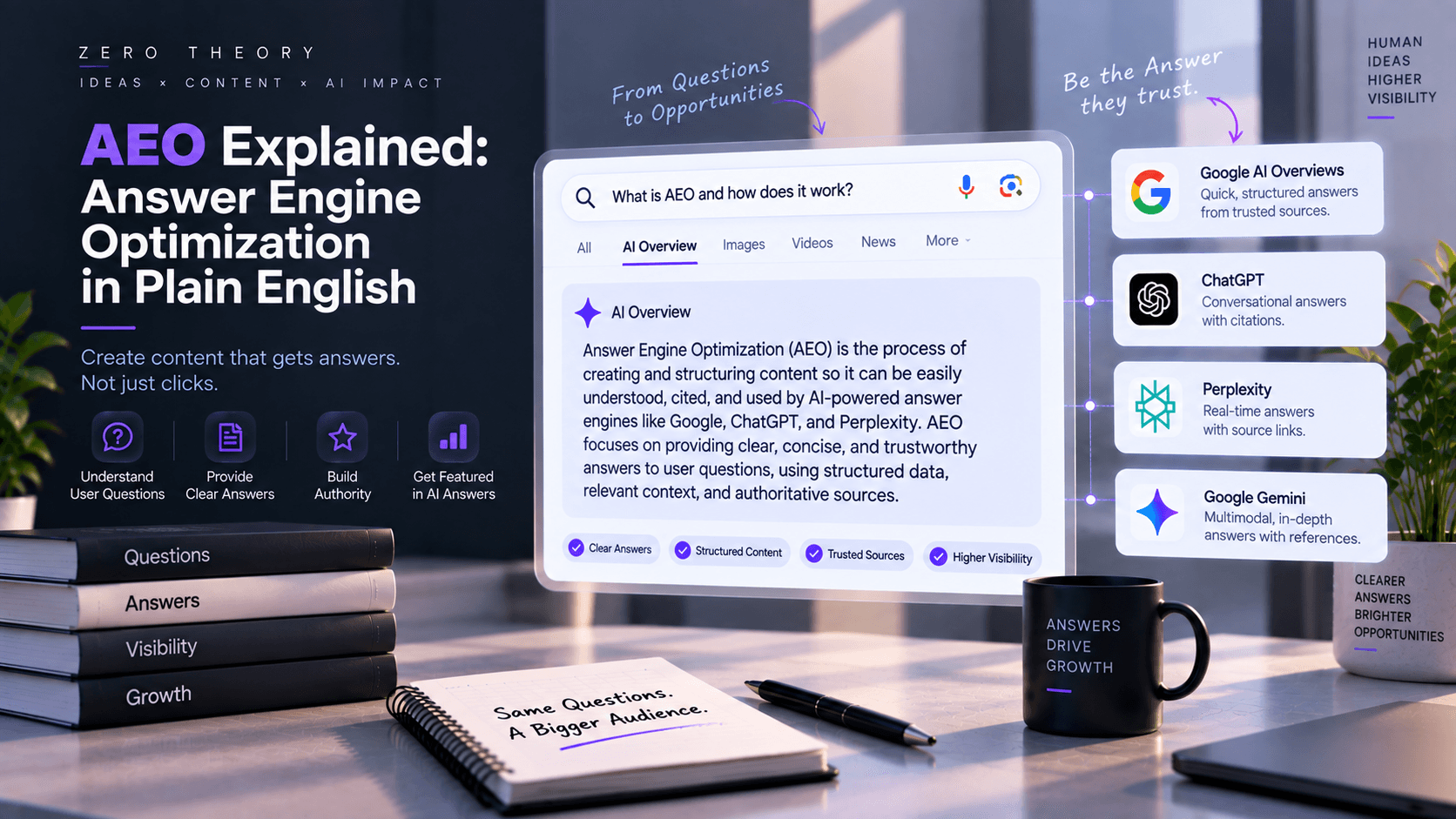
AEO is changing how businesses create content for search in an era where users increasingly expect direct answers instead of traditional search results. This guide explains Answer Engine Optimization in plain English, how AEO works, how it differs from traditional SEO, and the key strategies brands can use to make their content more visible in answer-focused search experiences.
AEO sounds complicated. It isn't.
AEO stands for Answer Engine Optimization, and in plain terms it means creating and organising content so search engines, answer engines, and AI systems can quickly understand the answer to a user's question. If SEO asks "how do I get my page discovered and ranked?", AEO asks "how do I make my page the clearest answer to the question?" GEO then goes further, asking "how do I make my brand understandable and visible inside AI-generated answers?" That's the easiest way to see the difference, and it's why Zero Theory treats SEO, AEO, and GEO as connected disciplines in the GEO pillar rather than three separate channels.
What AEO is, and why it became important
Answer Engine Optimization is the practice of structuring content so it directly satisfies the questions users ask, with the emphasis on clear answers, question-based content, structured information, concise definitions, helpful explanations, relevant context, and strong evidence. It is not simply "add an FAQ section," which is one of the most common misunderstandings. It became important because search behaviour changed: people no longer search only in short phrases, they ask complete questions. Instead of "CAC formula" they ask "how do I calculate blended CAC for a D2C brand?" Instead of "GEO SEO difference" they ask "what's the difference between GEO and SEO, and do I need both?" Those longer questions create openings for content that answers them directly.
AEO is about the answer, not the keyword
Old keyword optimization produced pages like "Blended CAC: blended CAC is important because blended CAC..." That's not good writing. AEO encourages leading with a clean answer, "blended CAC is the total acquisition and marketing spend divided by the number of new customers acquired during a specific period", then explaining. The answer is immediate, and the reader knows they're in the right place. It doesn't replace SEO, though: Google's guidance stresses that traditional fundamentals remain relevant, pages still need to be accessible, indexable, and useful, so AEO sits on top of that foundation. SEO makes content discoverable, AEO makes the answer easy to understand, and GEO makes the brand useful inside AI experiences.
The anatomy of an AEO-friendly page
A good answer-focused page usually has a clear title, a direct introduction that answers the primary question early, question-based subheadings using the questions people actually ask, concise answers that don't bury the point, supporting detail that explains the reasoning, examples that make abstract ideas practical, evidence for important claims, and related questions that address natural follow-ups. Compare a weak opening ("businesses today are increasingly adopting modern marketing strategies...") with a strong one ("customer acquisition cost, or CAC, is the average amount a business spends to acquire one new customer..."). The first delays the answer; the second is AEO. The first 100 words matter, if someone reads only the introduction, they should still understand the basic answer.
Importantly, AEO isn't just for blog posts, it can improve service pages ("what does a GEO agency actually do?"), product pages, pricing pages, comparison pages, industry pages, and help pages. Every important page can answer questions. And FAQs help but aren't AEO on their own: bolting ten questions onto a vague page doesn't fix it, because AEO should run throughout the page, exactly the discipline behind content production without the slop.
How to write for AEO, and how it connects to AI Overviews
Use a five-step structure: identify the question the user actually wants answered, give the direct answer concisely, explain with context and nuance, demonstrate with examples or data, then expand into related questions. Write in simple language, "AI search systems retrieve information from multiple sources and use it to build an answer" beats "generative retrieval architectures facilitate multimodal information synthesis."
Back claims with evidence ("Google introduced Search Console reporting for generative AI features in 2026" beats "AI search is growing quickly"), and hold the E-E-A-T bar, Google emphasises helpful, people-first content with original information, so AEO shouldn't become an excuse for shallow answer pages. On AI Overviews specifically, Google says they use relevant links from the Search index and that existing SEO best practices remain the foundation, with no special "AEO markup" or schema that guarantees inclusion. That myth is worth removing.
Common mistakes and the simplest test
Avoid the usual traps: creating FAQ-only pages, giving vague answers, hiding the answer, writing for algorithms instead of people, spinning up hundreds of near-identical pages (which Google warns against), and ignoring evidence. The simplest AEO test is to open your page and ask "if I were a customer, could I find the answer to my main question within 10 seconds?" If yes, you're on track; if no, simplify. AEO works because it improves information architecture, it forces you to ask what the customer wants, what the answer is, what context they need, what evidence supports it, and what they'll ask next. AI search just makes those questions more important, and it makes AEO commercially useful on service pages too, where answering "what does a GEO agency do?", "who needs GEO?", and "how is GEO measured?" reduces buyer uncertainty.